
Peptide Freeze–Thaw Stability: Why Cycle Count, Container, and Matrix Must Be Reported
Direct answer: “freeze–thaw stable” is incomplete unless the record states the peptide, matrix, concentration, container, freeze and thaw temperatures, dwell times, cycle count, mixing, and measured endpoint. A cycle can change recovery through aggregation, precipitation, adsorption, oxidation, or other chemical pathways. The relevant effect must be measured rather than assumed.
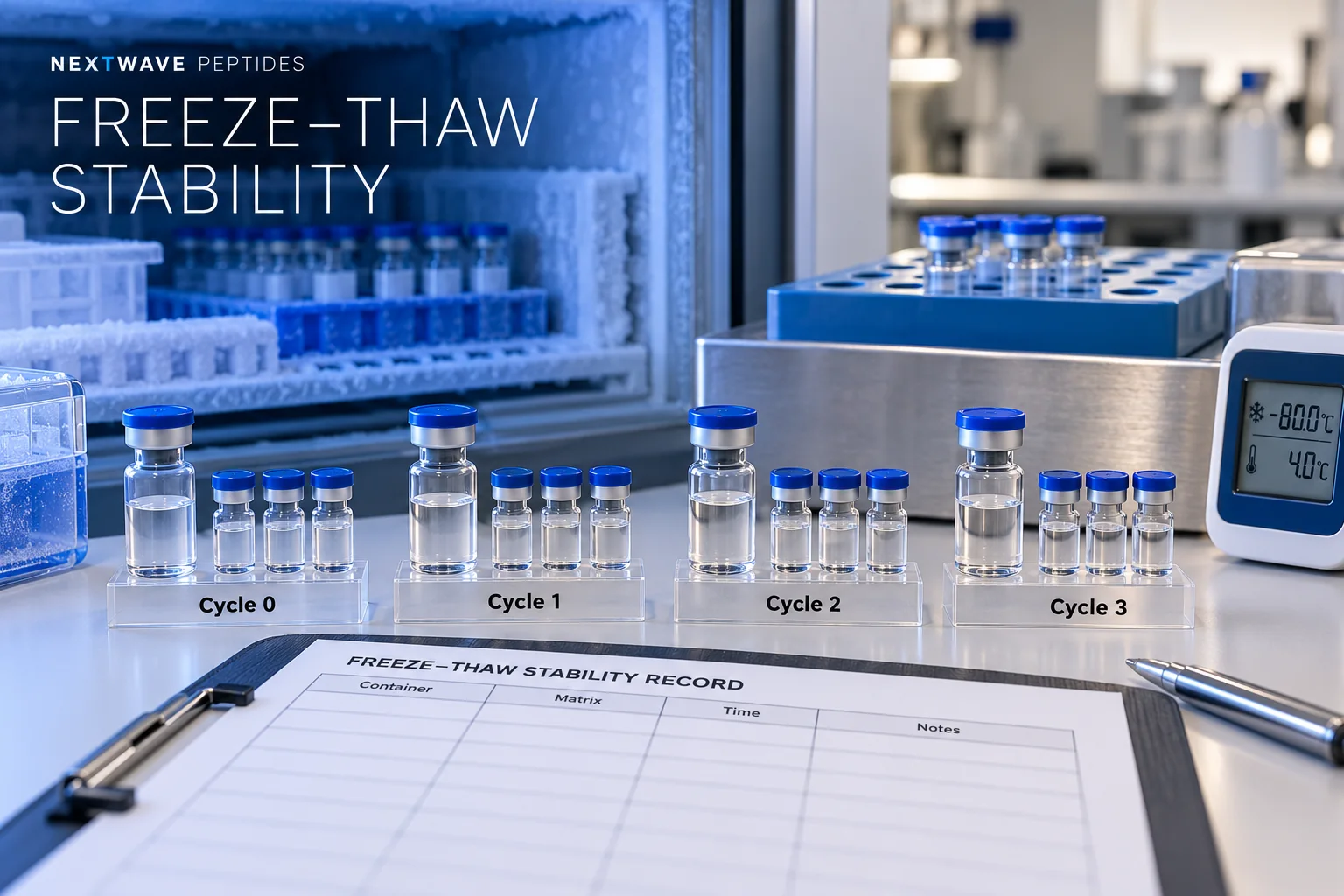
What counts as one freeze–thaw cycle?
A cycle should be defined operationally: starting state, freezing temperature and duration, thawing condition, time until fully thawed, mixing procedure, sampling point, and return to frozen storage. “Three cycles” from different laboratories may represent very different thermal histories. Partial thawing and repeated sampling can add temperature excursions that the headline count misses.
The peptide adsorption to labware guide explains why container surface and concentration can change apparent recovery. The research peptide calculation-tools guide provides a related principle: a calculation is only as interpretable as its inputs and units.
Which variables belong in the record?
| Variable | Why it matters | Example endpoint |
|---|---|---|
| Matrix and pH | Can change solubility and reaction pathways | Recovery, impurity profile |
| Concentration | Influences adsorption and association | Peak area versus time-zero control |
| Container and fill volume | Changes surface area and headspace | Recovery across matched vials |
| Freeze/thaw temperatures | Define thermal and phase history | Cycle-specific comparison |
| Cycle count and dwell time | Determine cumulative exposure | Trend across cycles |
| Mixing and visible state | Affect resuspension and sampling | Visual record plus analytical result |
Guidance for peptide standards used in mass-spectrometry assays recommends documenting generation, quantification, storage, and handling; the underlying study also observed that vial material and repeated freeze–thaw treatment could affect measured peptide recovery in a sequence-dependent way (PubMed 26719571). The FDA's adopted ICH M10 bioanalytical guidance describes freeze–thaw stability testing in the matrix and under conditions that reflect sample handling, including repeated cycles where applicable (FDA ICH M10 guidance). That framework concerns validated bioanalytical samples and should not be presented as a storage instruction for every peptide product.
What should be measured after cycling?
Choose endpoints that match the failure mode. RP-HPLC may track soluble peak patterns; LC-MS may evaluate intact mass and selected modifications; SEC or light scattering may address size-related changes; and recovery against a time-zero control may reveal loss. Visual clarity is useful to record, but it does not identify precipitate or prove chemical stability.
A recent glucagon study used differential scanning calorimetry and complementary measurements to investigate aggregation under freezing and thawing conditions, illustrating why thermal behavior and analytical outcomes should be connected rather than inferred from temperature alone (PubMed 39489188). The peptide aggregation methods guide explains why SEC, DLS, and RP-HPLC can disagree.
How should catalog materials be compared?
Do not transfer a freeze–thaw conclusion across sequences or formulations. A Semax research material, TB-500 research material, and KLOW blend research material differ in composition and analytical behavior. Use the research compounds collection to locate exact records, then check available batch documentation through the NEXTWAVE PEPTIDES COA library. If a test was not performed, state that directly.
Research limitations
Freeze–thaw effects are peptide-, matrix-, concentration-, container-, and method-specific. Forced or repeated cycling can reveal a vulnerability but may not represent ordinary laboratory handling. Some literature uses biological matrices or formulated therapeutic peptides, so its results cannot establish the stability of another material. This article does not provide dosing, human-use, or product-storage instructions.
Frequently asked questions
Is one freeze–thaw cycle always harmless?
No universal conclusion is valid. The effect depends on the material, matrix, container, and measured endpoint.
Are aliquots preferable for a stability experiment?
Aliquots can isolate cycle histories and reduce repeated access, but the protocol must control vial, fill, and preparation differences.
Does a clear solution prove stability after thawing?
No. A clear appearance cannot exclude soluble aggregates, chemical modifications, or recovery loss.
Can a COA answer freeze–thaw stability?
Only if it contains a relevant, clearly described test. Standard identity or purity fields do not automatically answer this question.