
Research Peptide Calculation Tools: How to Use Them Correctly
Research peptide calculation tools are useful when they make unit relationships explicit and keep an auditable record of inputs. They do not judge whether a source value is correct, whether a material identity is confirmed, or whether a planned experiment is appropriate. A defensible calculation therefore starts with the exact material, units, concentration basis, and intended laboratory operation before any number is entered.
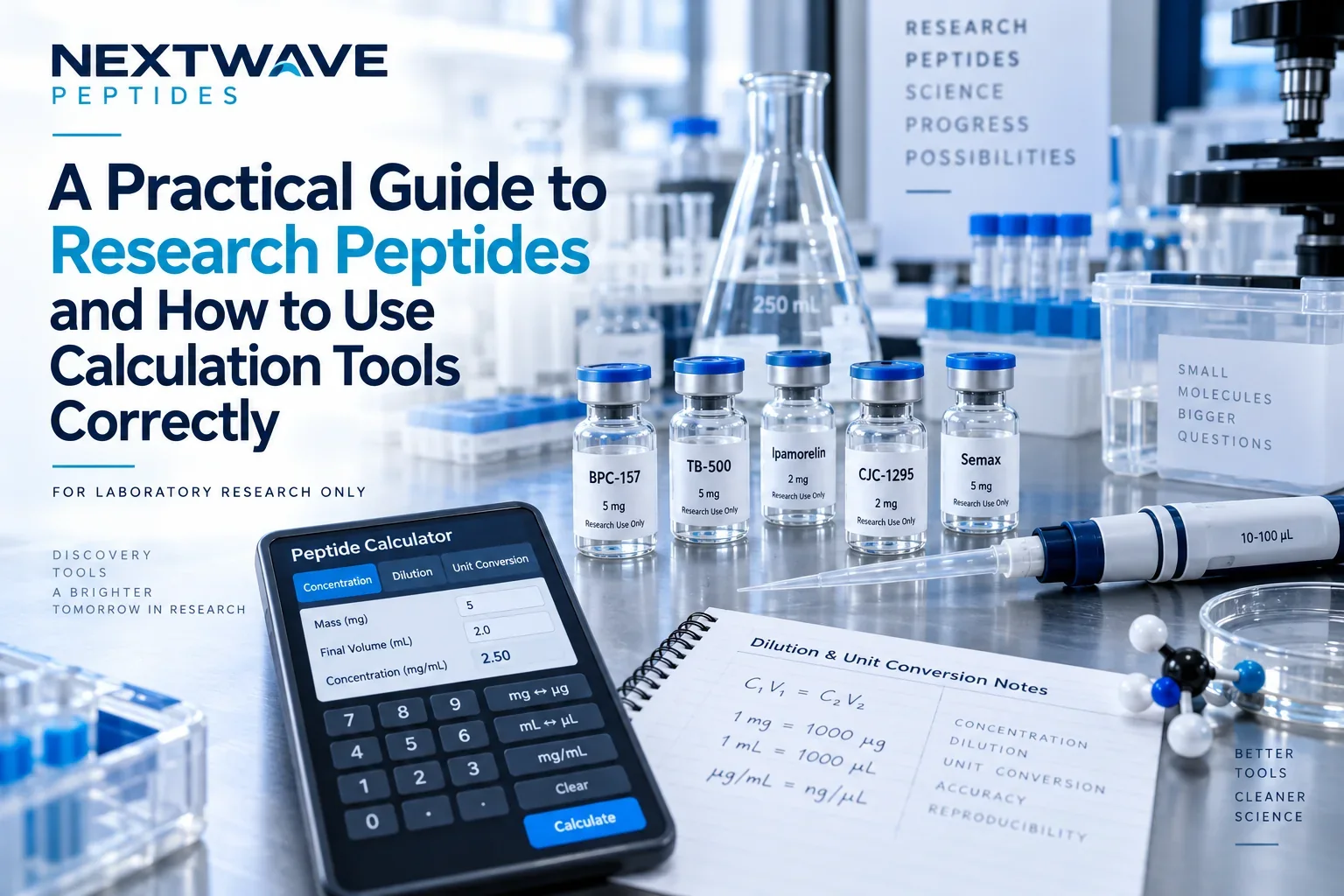
For NEXTWAVE PEPTIDES readers, the safest way to use a calculator is to treat it as a transparent arithmetic aid. Record the formula, units, input source, rounding rule, and result. Then check whether the result matches the product label, lot documentation, and the physical limits of the measuring equipment.
Start by naming the quantity
Mass, volume, mass concentration, amount concentration, and dilution factor are different quantities. A value in milligrams does not become a concentration until a volume is specified. A value in micromoles cannot be derived from milligrams without the molecular weight and a clear molecular form.
The BIPM SI Brochure defines the International System of Units and the relationships among base and derived quantities. The NIST Guide for the Use of the International System of Units gives practical conventions for symbols, prefixes, conversions, and reporting. These official references support unit handling; they do not validate a peptide label or an experimental plan.
A product record such as Retatrutide may state a mass per vial. That label is an input, not a result. The research peptide documentation workflow explains why the stated product identity, vial strength, lot record, and available COA should be checked before calculation.
Match the calculator to the question
| Laboratory question | Required inputs | Suitable relationship | Common mistake |
|---|---|---|---|
| What is mass concentration? | Mass and final solution volume | mass ÷ volume | Using added liquid volume when final volume differs |
| What volume contains a target mass? | Stock concentration and target mass | mass ÷ concentration | Mixing mg/mL with µg/µL without conversion |
| How is a stock diluted? | Initial concentration, target concentration, final volume | C1V1 = C2V2 | Applying the equation to different chemical species |
| What is amount concentration? | Mass concentration and molecular weight | mass concentration ÷ molecular weight | Ignoring salt, hydrate, or complex form |
| How much material supports a sample plan? | Replicates, material per sample, controls, overage | total across planned units | Treating a planning estimate as measured recovery |
The Peptide Calculator can organize mass and volume relationships, while the laboratory concentration and dilution calculator is better suited to stock-to-working-solution arithmetic. The research sample planner addresses replicates and planned overage. None of these tools replaces calibrated equipment or method validation.
Use one unit system before calculating
Convert every input to a compatible unit before applying a formula. Because 1 mg equals 1,000 µg and 1 mL equals 1,000 µL, a numerical value in mg/mL is equal to the same numerical value in µg/µL. That shortcut is valid because both numerator and denominator change by the same factor. It does not mean every unit pair is interchangeable.
The same rule applies when comparing labels across Semaglutide, Tirzepatide, or other records in the GLP-1 peptide collection: normalize the units first, but keep the compounds separate. Equal numeric concentrations do not establish equal molar concentration, receptor activity, stability, or assay response.
Know what C1V1 = C2V2 assumes
The dilution equation follows conservation of the amount of the same solute between an initial stock and a final mixture. It assumes that concentration definitions are compatible and that the final volume is known. It does not correct for adsorption, incomplete transfer, degradation, evaporation, density effects, or a mislabeled stock.
For small volumes, pipette operating range and uncertainty can dominate the arithmetic. A calculator may display many decimal places, but extra digits do not create measurement precision. Choose a practical transfer volume, document rounding, and avoid reporting more significant figures than the inputs and equipment support.
A five-step calculation check
- Identify the exact material and molecular form.
- Write every input with its unit and source.
- Convert inputs to one compatible unit system.
- Calculate with the appropriate relationship and retain an unrounded intermediate value.
- Check the result by reversing the calculation and compare it with equipment limits.
The peptide product-page checklist is useful before step one, and the guide to 99% peptide purity explains why a chromatographic purity value should not be substituted for mass, content, or concentration.
The peptide A280 concentration guide explains when an extinction coefficient, blank, path length, and sequence make a UV calculation interpretable.
Research limitations
Arithmetic cannot establish material identity, purity, content, sterility, stability, recovery, or fitness for an experiment. A label value and a COA result describe different evidence. Calculated concentration is nominal unless confirmed by a suitable analytical method. These tools are intended for laboratory planning and documentation, not human or veterinary use.
Frequently asked questions
Is mg/mL the same as µg/µL?
The numerical values are equal because both mass and volume are scaled by 1,000. The written unit should still match the instrument, protocol, and record being used.
Can a calculator convert milligrams directly to micromoles?
Only when the molecular weight and molecular form are known. Salt, hydrate, metal-complex, or conjugated forms can change the relevant molecular mass.
Does C1V1 = C2V2 account for peptide loss?
No. It is an ideal conservation relationship. Adsorption, degradation, incomplete transfer, and analytical recovery require separate evidence.
Should every displayed decimal be reported?
No. Report precision should reflect the least precise input and the capability of the measuring equipment.