
Peptide Adsorption to Labware: Why Low-Concentration Recovery Can Fall
Peptides can adsorb to tubes, pipette tips, filters, autosampler vials, and instrument surfaces. The loss is often proportionally larger at low concentration or after repeated transfers, so a falling analytical signal may reflect surface loss rather than chemical degradation.
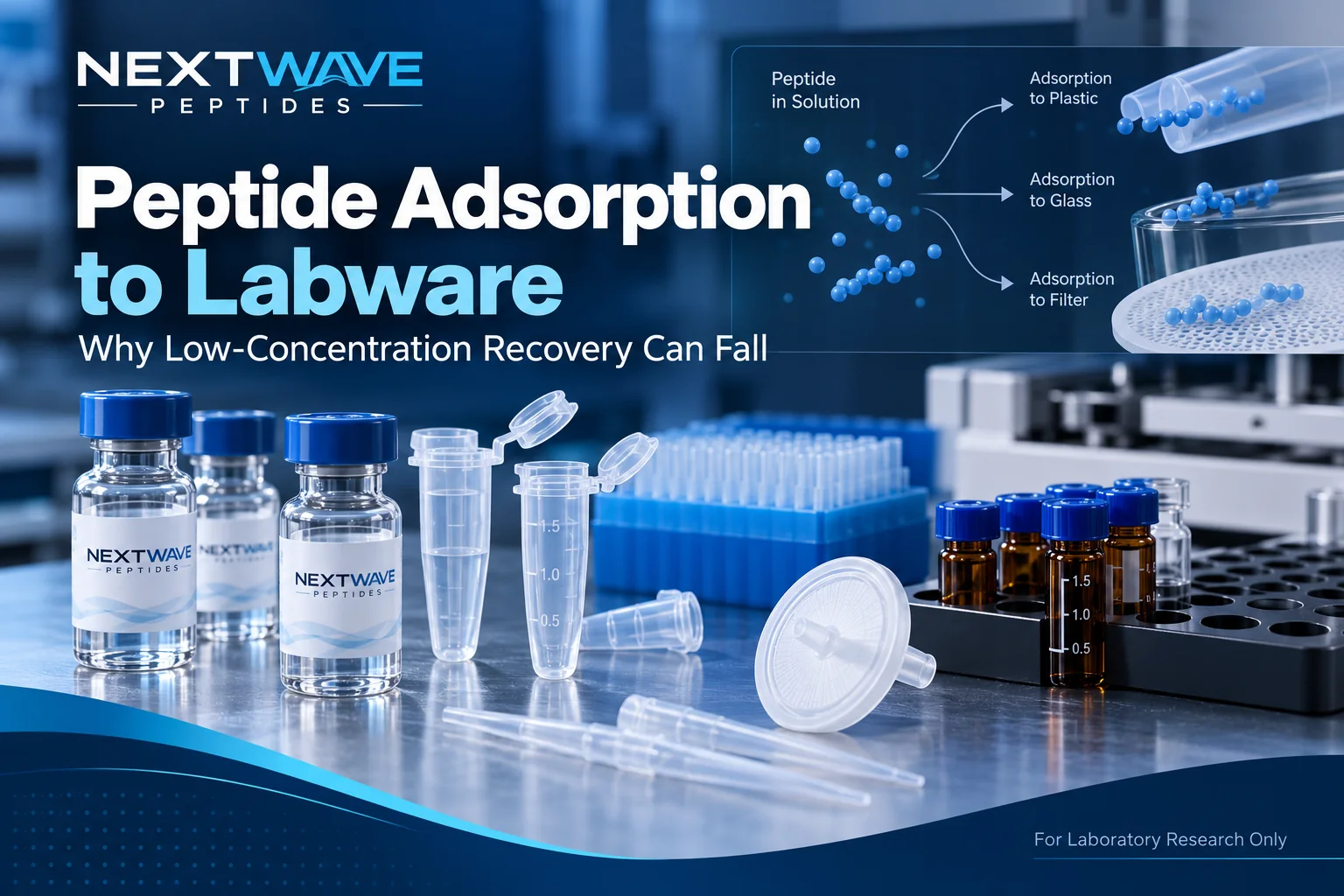
Adsorption is a mass-balance problem
A container wall creates a surface on which peptide molecules may bind through hydrophobic, electrostatic, or other interactions. The fraction lost depends on peptide sequence, concentration, surface chemistry, contact area, time, solvent, and competing molecules. “Polypropylene” or “glass” alone is therefore not a complete recovery specification.
An early NIH PubMed study of atrial natriuretic peptide reported measurable adsorption to several materials and substantial cumulative loss during serial transfers in its stated buffer system. A recent NIH PubMed intact-peptide LC-MS study showed that low-bind vials and adsorption competitors improved response for the particular peptide and proteins tested. These findings demonstrate the mechanism and experimental risk; they do not supply a universal correction factor for every peptide.
Where apparent loss can enter the workflow
| Step | Possible surface effect | Useful control | Remaining limitation |
|---|---|---|---|
| Stock transfer | Binding to tube or tip | Transfer-count comparison | Does not locate chemical degradation |
| Dilution series | Larger fractional loss at low concentration | Independently prepared standards | Matrix may differ across levels |
| Filtration | Retention on membrane or housing | Pre/post-filter recovery | Filter extractables may add another variable |
| Autosampler hold | Time-dependent vial adsorption | Time-zero and hold-time samples | Temperature and solvent also change stability |
| LC-MS analysis | Carryover or adsorption in the flow path | Blank sequence and wash study | Signal suppression can coexist |
The Oxytocin LC-MS sample-preparation guide explains why extraction recovery belongs beside the final signal. The same logic applies before extraction: a method cannot recover material that has already been lost to an upstream surface.
Why dilution can stop looking linear
If a roughly fixed amount binds to available surface, the percentage remaining in solution can be much lower in a dilute sample than in a concentrated one. Repeated transfers increase fresh surface exposure. At the other end of the range, ion suppression or detector saturation can also bend a calibration curve. The pattern alone does not identify the cause.
A defensible investigation changes one variable at a time: container type, transfer count, contact time, concentration, solvent composition, or blocking strategy. Measure both recovery and carryover where possible. The broader sample-handling lesson from GSH and GSSG shows why preanalytical changes must be documented rather than corrected after the fact.
Build recovery into the experimental record
Record the exact labware, nominal concentration, fill volume, contact time, number of transfers, storage temperature, and sample matrix. Use low-bind materials only after verifying them for the target peptide and method. A carrier protein or surfactant may reduce adsorption in one assay but interfere with another, so it is not a universal fix.
For catalog navigation, the issue can be considered when developing methods for Semax, GHK-Cu, or Retatrutide from the Research Compounds collection. These links identify materials; they do not claim that a particular lot has been tested for surface recovery. Use the NEXTWAVE PEPTIDES catalog and relevant lot documentation to keep material identity separate from method development.
Research limitations
Adsorption is sequence- and method-dependent. Results from one peptide, concentration range, or container brand cannot be transferred unchanged to another. Apparent loss may also include precipitation, aggregation, proteolysis, oxidation, incomplete extraction, matrix effects, or instrument response. Only a controlled mass-balance or recovery study can separate those explanations. No handling condition in this article is a validated instruction for an unstated material.
Frequently asked questions
Does low-bind plastic eliminate peptide loss?
No. It can reduce adsorption in a defined experiment, but performance still depends on peptide, concentration, solvent, time, and workflow.
Can adding more peptide solve the problem?
Higher concentration may reduce fractional loss, yet it also changes the experiment and may create solubility, aggregation, or detector-linearity problems.
Is poor recovery the same as degradation?
No. Degradation creates or removes chemical species; adsorption relocates material to a surface. Both can occur together and require different evidence.
Why test repeated transfers?
Each transfer exposes the sample to another tip or vessel surface. A transfer-count experiment can reveal cumulative loss that one-container stability testing misses.