
Peptide Aggregation Analysis: Why SEC, DLS, and RP-HPLC Answer Different Questions
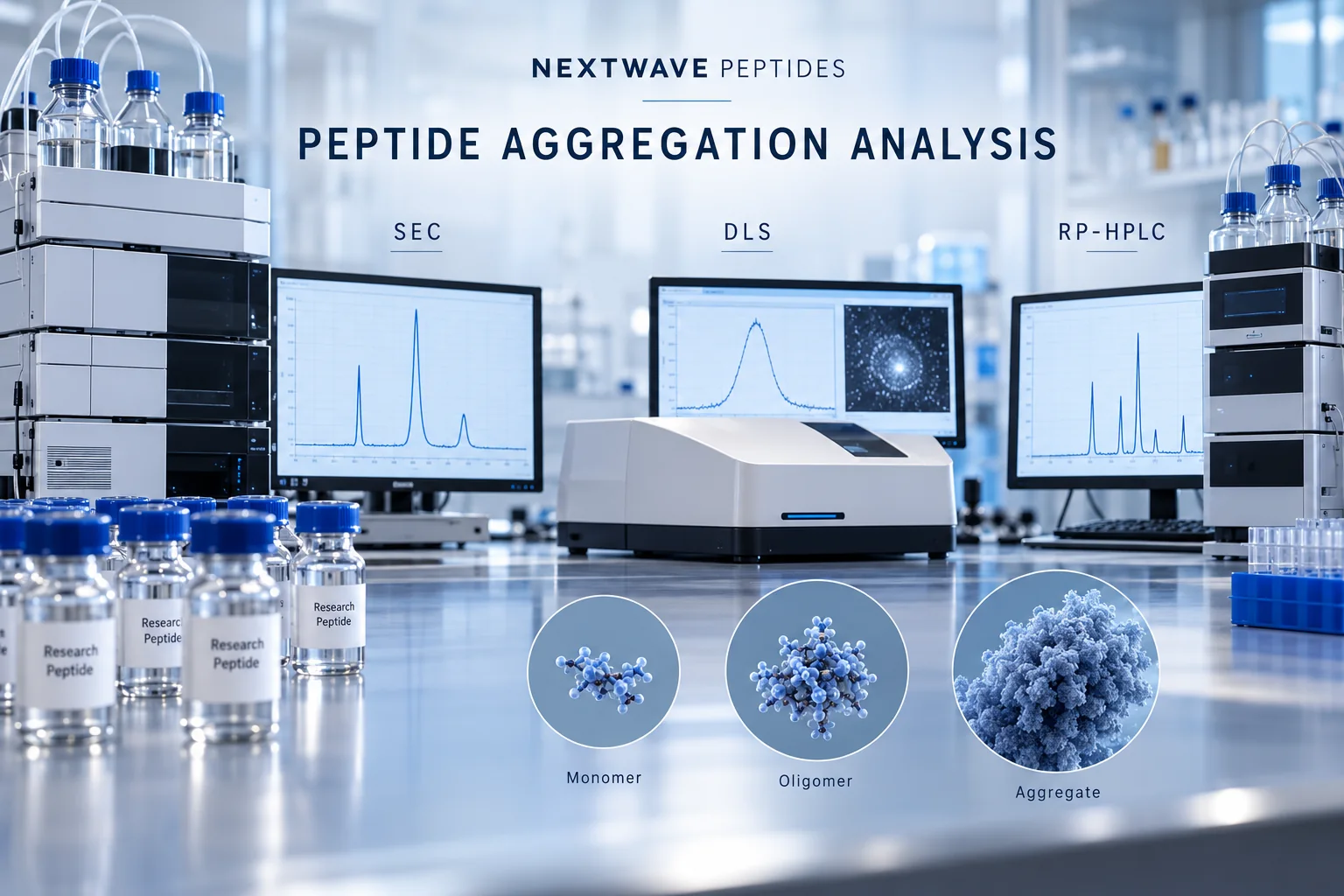
Direct answer: SEC, DLS, and RP-HPLC do not measure “aggregation” in the same way. Size-exclusion chromatography separates soluble species by hydrodynamic behavior, dynamic light scattering estimates particle-size distributions in the measured suspension, and reversed-phase HPLC separates species by interaction with a hydrophobic stationary phase. Agreement strengthens an interpretation; disagreement often reveals a method blind spot.
Why one aggregation number is incomplete
Peptide association can range from reversible oligomers to large particles or fibrils. Some species remain soluble; others adhere to surfaces, are removed by filters, dissociate during chromatography, or fall outside a detector's useful range. A single result therefore needs the method, sample preparation, concentration, matrix, temperature, and elapsed time beside it.
This is closely related to peptide adsorption to labware: apparent loss can arise from surfaces as well as association. The HPLC, LC-MS, and amino-acid-analysis guide explains why orthogonal methods should retain separate claims.
What each method contributes
| Method | Primary view | Common blind spot |
|---|---|---|
| SEC | Relative amount of soluble size-separated species | Column interaction, dilution, filtration, or dissociation can change the sample |
| DLS | Intensity-weighted hydrodynamic size in suspension | A small number of large particles can dominate scattering |
| RP-HPLC | Hydrophobicity-resolved soluble components | Native assemblies may dissociate in organic mobile phase |
| SEC-MALS | Separation plus molar-mass information | Still depends on recovery through the chromatographic system |
| Microscopy or particle imaging | Larger-particle count and morphology | Limited view of small soluble oligomers |
A peptide-specific study developed SEC-LC-UV/HRMS to separate and identify stress-induced liraglutide aggregates, demonstrating the value of joining size separation with mass information (PubMed 39113387). A separate peptide study used light scattering, spectroscopy, and microscopy together because no single measurement described aggregate size, conformation, and morphology (PubMed 33035751). Protein-model comparisons also show that SEC may miss material retained by a filter or column while DLS remains sensitive to high-molecular-weight particles; those findings illustrate a limitation, not a universal correction factor (PubMed 28578190).
How to investigate disagreement
If DLS suggests large particles but SEC shows mostly monomer, first review sample concentration, dust controls, filtration, injection recovery, and whether the assembly could dissociate during dilution or chromatography. If SEC shows an early-eluting peak while DLS does not, examine the DLS intensity distribution, replicate variability, and concentration range. If RP-HPLC changes without a size signal, chemical modification or a conformational change may be more plausible than a stable aggregate, but LC-MS or another identity method is still needed.
The peptide concentration by A280 guide is useful when interpreting UV-based chromatograms because an extinction coefficient and baseline determine what the detector response means. Batch claims should be checked against the actual methods listed in the NEXTWAVE PEPTIDES COA library.
For compound-specific records, do not transfer aggregation behavior between a lipidated Retatrutide research material, a copper complex such as GHK-Cu research material, and Semax research material. The research compounds collection is a catalog route; each molecule still requires its own method suitability.
Research limitations
Aggregation depends on sequence, chemical modifications, concentration, matrix, surfaces, agitation, temperature, and time. Several cited comparisons use therapeutic proteins or stressed model systems, so their observations cannot be assigned to another peptide or batch without direct measurement. DLS does not identify particles chemically, and chromatographic peak area is method-dependent. This article describes analytical design, not product performance or human use.
Frequently asked questions
Is SEC the definitive aggregation test?
SEC is powerful for soluble size variants, but recovery and method-induced changes must be checked with orthogonal evidence.
Why can DLS change sharply after a few particles appear?
Scattering intensity rises strongly with particle size, so a small large-particle population can dominate the signal.
Can RP-HPLC prove a peak is an aggregate?
No. It can show a separated component under the method. Structural assignment needs additional evidence.
Should samples be filtered before all three tests?
Only when the protocol and question justify it. Filtration can remove the very species being investigated and must be recorded.