
Semaglutide Ingredients: Active Peptide, Excipients, and Product Form
Direct answer: semaglutide is the active peptide ingredient, but “semaglutide ingredients” cannot be answered with one universal list. FDA-approved injections and tablets use different inactive ingredients, and a research material has a different documentation purpose from a finished medicine. The exact brand, dosage form, label revision, and material form must stay attached to any ingredient list.
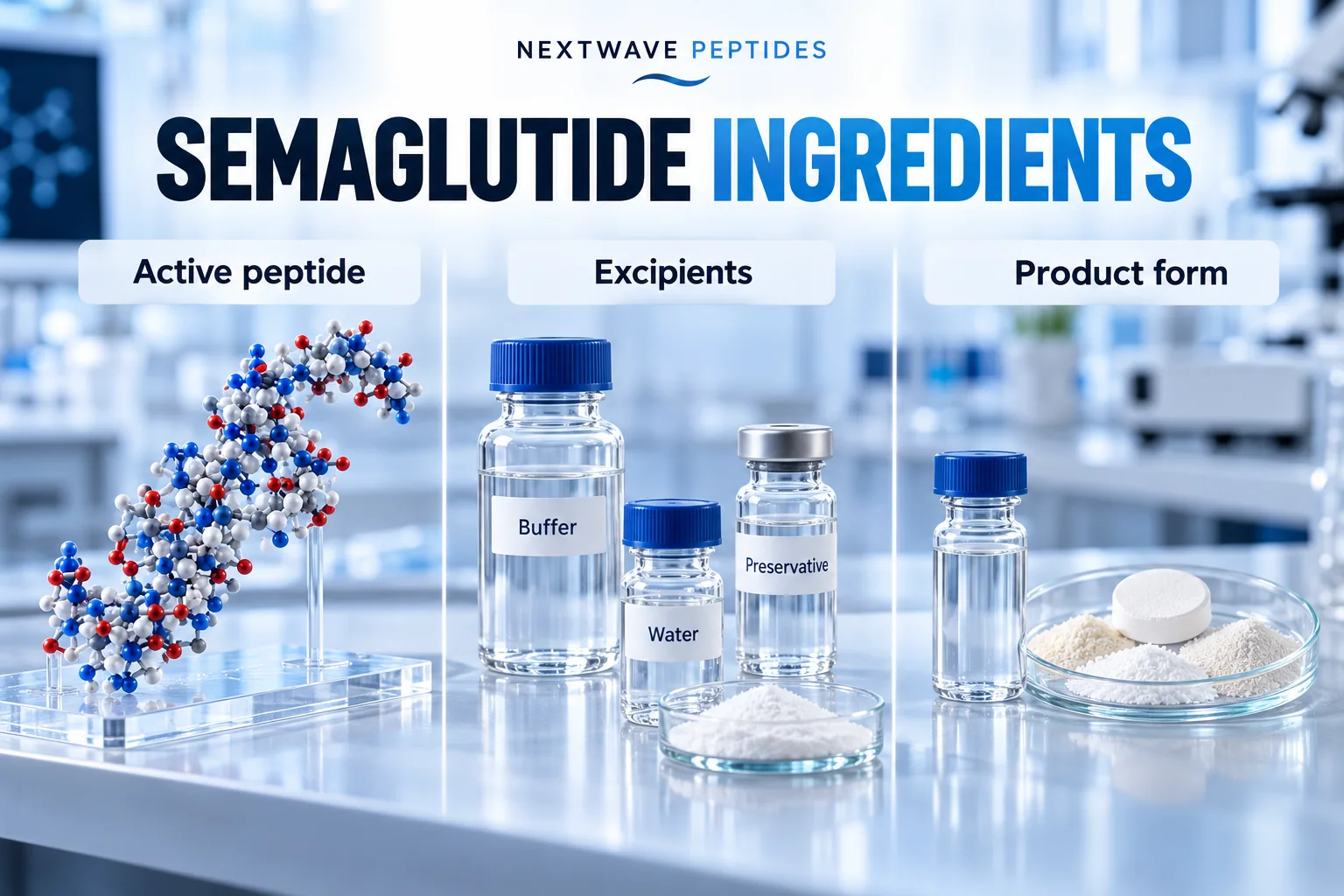
Active ingredient and finished formulation are separate records
The semaglutide molecule is a modified GLP-1 analogue. A finished drug product also contains formulation ingredients chosen for stability, delivery, preservation, tonicity, pH, or manufacturing. Those excipients are not part of the semaglutide peptide sequence.
Current U.S. labeling for Ozempic injection lists semaglutide as the active ingredient and describes disodium phosphate dihydrate, propylene glycol, phenol, and water for injection among the inactive ingredients, with acid or base used when needed for pH adjustment (DailyMed: Ozempic professional label). Current Wegovy labeling distinguishes its injection from its tablet formulation: the injection and tablet do not share the same inactive-ingredient list (DailyMed: Wegovy label).
Why one ingredients list can be misleading
| Record being discussed | Active component | Other fields that must be named |
|---|---|---|
| Semaglutide molecule | Defined modified peptide | Sequence, Aib substitution, lipidation, terminal form |
| Approved injection | Semaglutide | Brand, concentration, buffer, tonicity agent, preservative, water, label revision |
| Approved tablet | Semaglutide | Brand, tablet excipients, absorption enhancer, strength, label revision |
| Compounded preparation | Claimed active ingredient | Compounder, exact formulation, source, applicable legal status |
| Research material | Intended semaglutide form | Lot, salt/counterion if stated, content, purity method, analytical scope |
The FDA has separately warned that unapproved versions of semaglutide may use salt forms such as semaglutide sodium or semaglutide acetate, which are different active ingredients from the semaglutide base used in approved products. The agency also emphasizes that compounded drugs are not FDA approved and do not undergo the same premarket review (FDA: Concerns with Unapproved GLP-1 Drugs).
Does molecular formula describe all ingredients?
No. A molecular formula describes the elemental composition of a defined molecule under a stated convention. It does not list buffer salts, preservatives, water, tablet excipients, or packaging-contact materials. FDA labeling gives semaglutide the molecular formula C187H291N45O59 and molecular weight 4113.58 g/mol, but those values describe the active molecule rather than the full contents of a pen or tablet.
The semaglutide design guide explains why the Aib8 substitution and C18 lipidation solve different molecular-design problems. The peptide salt-form guide shows why counterion, purity, and quantitative peptide content must remain separate. The COA reading guide explains how to check which material attributes were actually tested.
Why formulation names matter
Ozempic, Wegovy, and Rybelsus are product names tied to particular FDA-approved applications and labels. Sharing semaglutide as an active ingredient does not make their formulations interchangeable. Route, dosage form, concentration, inactive ingredients, container system, and approved uses differ.
Likewise, Semaglutide research material is not a finished prescription product. A research-material record should identify the intended molecule, lot, analytical methods, and stated form without copying an approved drug's excipient list onto the research vial. Related Tirzepatide research material and Retatrutide research material have different molecular identities. The GLP-1 research collection groups catalog records for navigation, not ingredient equivalence.
A practical verification sequence
First identify the exact product and route. Next open the current official label and locate Description, Dosage Forms, and inactive-ingredient sections. Separate the active molecule from formulation excipients. For a research material, use the product specification and lot-matched report in the NEXTWAVE PEPTIDES COA library. If a field is absent, record it as not stated rather than filling it from another product.
For storage claims, the semaglutide refrigeration guide compares current product-specific records and explains why one formulation's instructions cannot be transferred to another.
Research limitations
Formulations and labels can change. Ingredient lists in one country or brand do not automatically apply to another. This article summarizes U.S. sources checked on October 23, 2026 and does not replace the current official label. It does not provide administration, compounding, dosing, or medical advice, and it does not establish the composition of any untested batch.
Frequently asked questions
Is semaglutide the only ingredient in Ozempic?
No. Semaglutide is the active ingredient; the injection also contains labeled inactive formulation ingredients.
Do Ozempic, Wegovy, and Rybelsus have identical ingredients?
No. They share semaglutide as an active ingredient but use different dosage forms and excipient systems.
Is semaglutide sodium the same as the active ingredient in approved products?
FDA says semaglutide salt forms are different active ingredients from the semaglutide base used in approved products.
Does a COA list every formulation ingredient?
Only if the document explicitly includes and tests those fields. Many COAs focus on identity, purity, or content instead.