
Peptide Salt Forms: Why TFA, Acetate, and Peptide Content Are Separate Records
Peptide salt form identifies counterions associated with charged groups; it does not replace sequence identity, chromatographic purity, or quantitative peptide content. Two samples can contain the same peptide sequence yet differ in counterion and net peptide fraction, so comparisons should record all four fields separately.
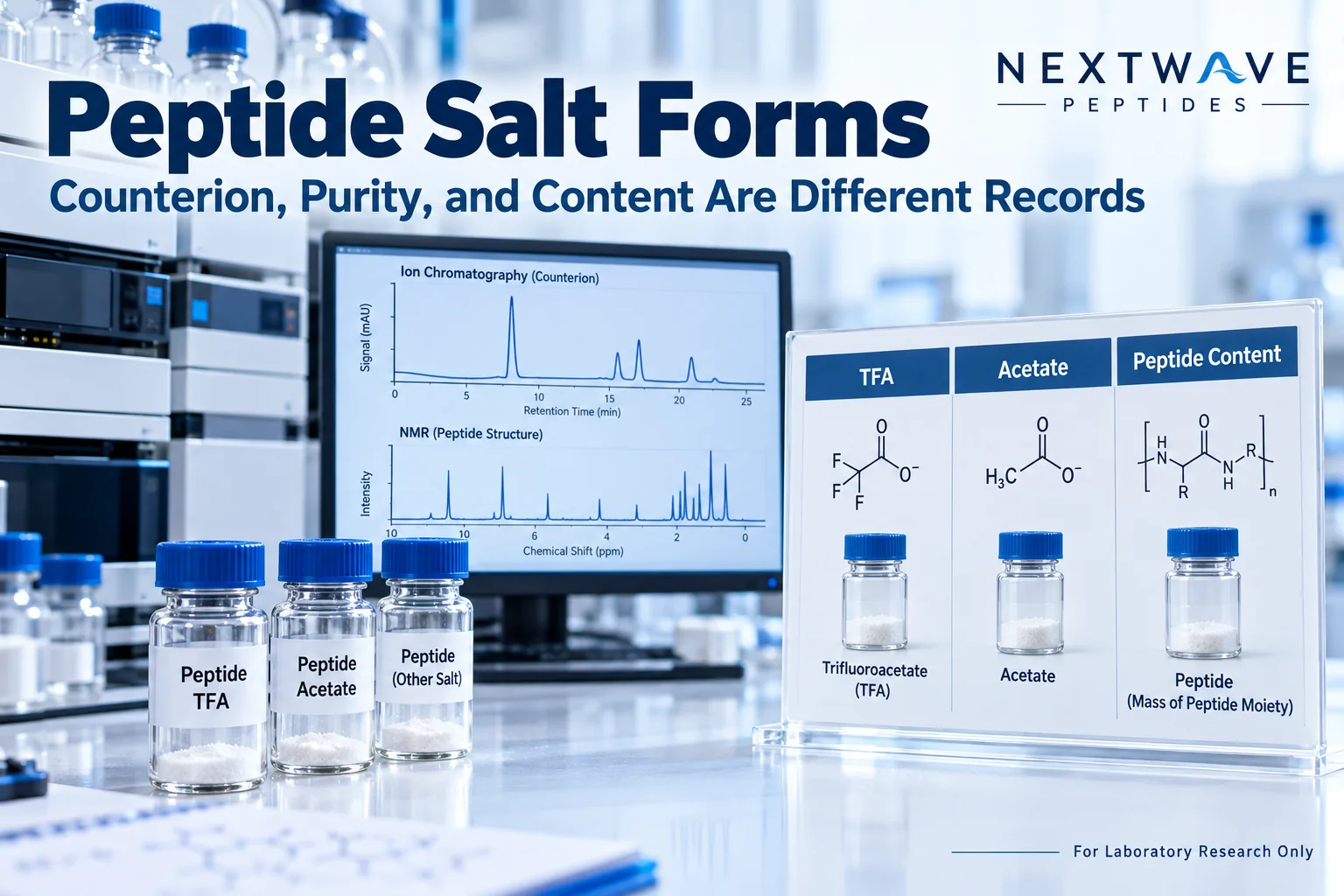
Why synthetic peptides carry counterions
Many synthetic peptides contain protonated amino groups and are isolated as salts. Trifluoroacetic acid is commonly used during solid-phase synthesis and reversed-phase purification, so trifluoroacetate can remain as the counterion unless an exchange step is performed. Acetate and chloride are other possible forms.
A 2025 NIH PubMed study of TFA analysis and exchange compared FT-IR, fluorine NMR, and HPLC-ELSD approaches and showed that counterion measurement and exchange are analytical operations of their own. A separate NIH PubMed peptide-fraction study reported materially different peptide fractions among preparations with similar headline purity. These sources concern their named materials and experiments; they do not establish the salt form or content of an unrelated lot.
Four results that should not be merged
| Record | Question answered | Suitable evidence | What it does not prove |
|---|---|---|---|
| Sequence identity | Is the amino-acid order consistent with the target? | Sequence-resolved MS/MS, reference comparison | Counterion amount or absolute content |
| Chromatographic purity | How much included detector response belongs to the main peak? | Defined HPLC or UPLC method | Peptide fraction by dry mass |
| Counterion | Which ion and how much are present? | Ion chromatography, NMR, or another validated method | Peptide sequence |
| Peptide content | How much target peptide is present on the stated basis? | Quantitative assay with calibration and units | Biological performance |
This separation explains why “99% HPLC purity” cannot automatically be read as “99% peptide by weight.” Water, counterions, residual solvent, and nonchromophoric material may not be represented by a relative peak-area result. The 99% peptide purity guide explains that detector response and mass fraction are different quantities.
How salt form changes a calculation
Molar work requires a clearly defined molecular-weight basis. A calculation may use the neutral peptide, a stated salt, or an experimentally measured peptide content. Those bases are not interchangeable. The research peptide calculation guide shows why units and material basis must be written before arithmetic begins.
For a hypothetical record, “10 mg vial” states a nominal total mass, while “85% peptide content” states a different quantity. Neither value should be inferred from HPLC area percent. If the counterion or water result is absent, mark it not reported instead of back-calculating an assumed value.
A practical review sequence
Start with the written sequence and terminal modifications. Record the salt form exactly as supplied, then locate any quantitative counterion and water results. Next, identify whether the content result is expressed on an as-is, anhydrous, or counterion-free basis. Only then choose the molecular weight and concentration basis for a calculation.
The research documentation workflow keeps product, lot, analytical, and literature records separate. For examples of named catalog forms, compare Retatrutide, Semaglutide, and Sermorelin Acetate within the Research Compounds collection. The product title is a starting identifier; the lot-matched COA library is where reported analytical fields should be checked.
Research limitations
Counterion stoichiometry can depend on sequence charge, exchange procedure, purification history, water content, and analytical method. A paper that compares TFA and another salt for one peptide does not establish the same behavior for a different sequence. Public product wording also cannot substitute for a lot-specific assay. This article explains record interpretation and does not provide preparation, dosing, or human-use instructions.
Frequently asked questions
Is acetate always better than TFA?
No universal ranking follows from the counterion name. Suitability depends on the stated research question, material specification, analytical evidence, and matrix.
Does counterion exchange change the peptide sequence?
The intended operation changes associated ions rather than amino-acid order, but the finished material still needs appropriate identity and quality checks.
Can HPLC purity quantify residual TFA?
Not automatically. A peptide purity chromatogram and a counterion assay answer different questions unless a method has been designed and validated to measure both.
Which molecular weight belongs in a molar calculation?
Use the molecular form and content basis defined by the record and method. If the salt or solvation state is uncertain, state that uncertainty rather than selecting a convenient value.