
Semaglutide Design: Why Aib8 and C18 Acylation Solve Different Problems
Semaglutide uses two separate design strategies that should not be merged into one claim. The Aib substitution near the N-terminus reduces susceptibility to DPP-4 cleavage, while the C18 fatty-diacid side chain promotes albumin association and changes exposure. One feature addresses enzymatic stability; the other changes distribution and persistence.
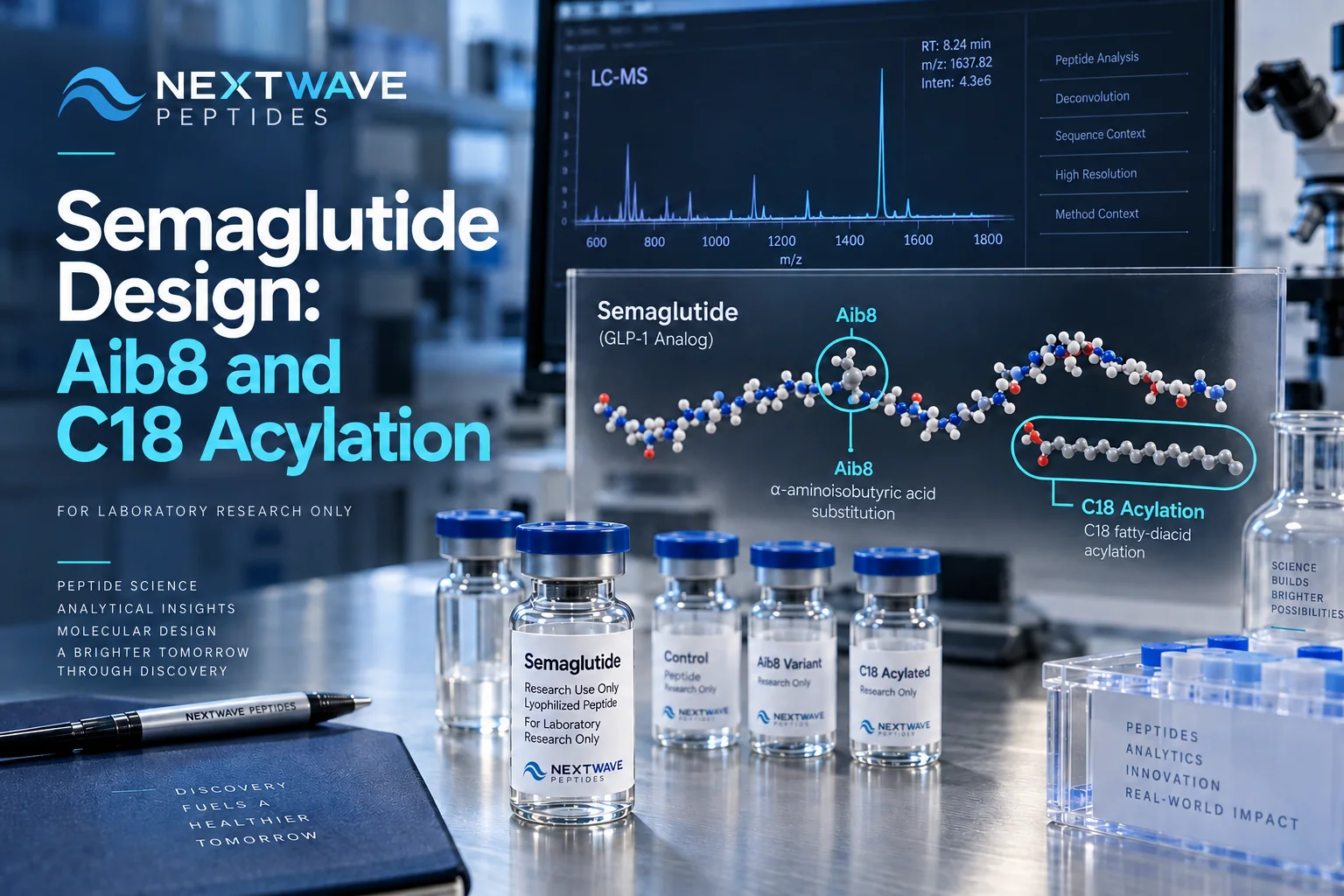
This distinction matters when reading a Semaglutide record or comparing it with Tirzepatide and Retatrutide. Similar language about “long acting” can hide different structures, linkers, albumin interactions, receptor profiles, and assay conditions.
What Aib8 changes
Native GLP-1 has an alanine at the position commonly numbered 8 in GLP-1 pharmacology. DPP-4 recognizes the N-terminal region and rapidly cleaves susceptible peptides. In semaglutide, 2-aminoisobutyric acid, abbreviated Aib, replaces that alanine. Aib is a non-proteinogenic amino acid, so the substitution changes the local substrate recognized by the enzyme.
The original NIH PubMed semaglutide discovery paper describes the sequence engineering and acylation work that produced the analogue. It supports the design history of the molecule; it does not establish the identity or quality of any independently supplied research lot.
Aib substitution is therefore an identity feature that sequence mapping or a suitable reference comparison should address. A correct intact mass can support composition, but the peptide stereochemistry guide explains why mass alone cannot always locate or distinguish residue configuration.
What C18 acylation changes
Semaglutide carries a C18 fatty diacid attached through a spacer to a lysine side chain. The acyl chain increases reversible albumin association. Albumin binding can reduce the freely available fraction in some experimental systems and can alter apparent potency, distribution, and clearance.
This is a different mechanism from DPP-4 resistance. A DPP-4 incubation examines proteolytic susceptibility. An albumin-binding experiment examines association under defined protein, buffer, temperature, and concentration conditions. A receptor assay measures functional signaling. None can replace the others.
The PubChem semaglutide record provides an authoritative chemical-identity reference. For receptor-structure context, the analysis of Tirzepatide and Semaglutide cryo-EM structures explains why a resolved receptor-bound region does not automatically describe the behavior of every flexible acyl chain or linker.
Evidence questions are not interchangeable
| Question | Relevant evidence | What it cannot establish alone |
|---|---|---|
| Is the Aib substitution present? | Sequence mapping, reference comparison, targeted MS/MS | Albumin affinity or receptor response |
| Is the acylated form present? | Intact mass plus site-specific peptide mapping | Free fraction in a biological matrix |
| Does the material associate with albumin? | Defined binding method with albumin concentration and temperature | DPP-4 resistance |
| Is the N-terminus protected from DPP-4 cleavage? | Time-course enzyme incubation with product mapping | Receptor potency |
| Does the molecule activate GLP-1R? | Controlled receptor assay | Lot purity, content, or stability |
The receptor-assay comparison shows why EC50 values need the receptor construct, readout, expression system, and incubation conditions. The same discipline applies when the GLP-1 peptide collection contains several acylated research materials with different molecular designs.
Practical record checks
A semaglutide identity record should state the complete molecular form rather than only the parent peptide name. Check whether the record identifies the modified residue, the linker and acyl group, the molecular mass basis, and the analytical method. If a COA reports chromatographic purity, do not assume that result localizes the Aib substitution or acylation site unless the method and data actually do so.
The Semaglutide research-record guide provides the broader receptor and lot-documentation context. This article focuses narrowly on why two structural features answer two different stability questions.
Research limitations
The cited design and pharmacology studies describe defined semaglutide materials and experimental systems. They do not verify a NEXTWAVE PEPTIDES lot, predict performance in an untested matrix, or establish human or veterinary use. Albumin binding, enzyme stability, receptor signaling, chromatographic purity, and content remain separate measurements.
Frequently asked questions
Is Aib8 the albumin-binding feature?
No. Aib8 changes the peptide near its N-terminus and reduces susceptibility to DPP-4 cleavage. Albumin association is primarily linked to the fatty-diacid side chain and spacer.
Can intact mass prove the acylation site?
Intact mass can support the total composition, but site localization generally requires sequence-resolved evidence such as targeted fragmentation or peptide mapping.
Does greater albumin binding mean greater receptor potency?
No. Albumin binding changes free concentration and exposure conditions. Receptor potency must be measured in a defined functional assay.
Does a purity percentage confirm both modifications?
Not by itself. Chromatographic purity describes the method’s resolved signal pattern. Modification identity and location require suitable orthogonal evidence.