
Oxytocin LC-MS Studies: Why Sample Preparation Is Part of the Result
In an oxytocin LC-MS study, sample preparation is part of the measurement result. Extraction recovery, adsorption, matrix effects, calibration, sample volume, and the defined analyte determine what a reported concentration can mean. Two studies can use mass spectrometry and still produce results that are not directly comparable because the material reaching the instrument was prepared differently.
Related research tool: Use the Laboratory Concentration and Dilution Calculator to check explicit mass-volume relationships and the Research Sample Planner to keep sample count, replicates and planned overage visible.
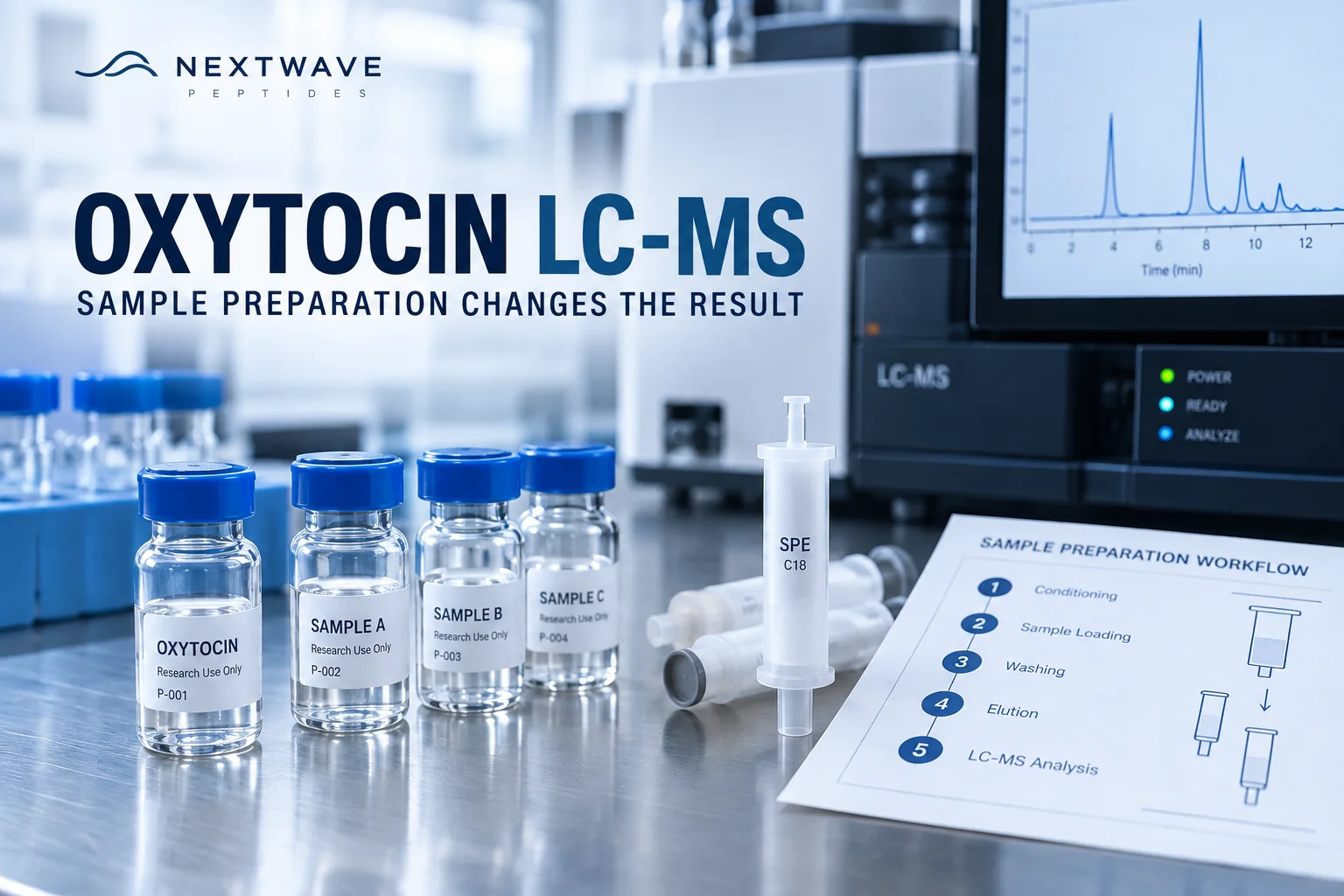
What does sample preparation change?
Mass spectrometry measures ions produced from the material that survives collection, handling, extraction, concentration, chromatography, and ionization. Oxytocin is present at low endogenous concentrations in biological samples, so losses or interference at any of those stages can materially change the signal. “Measured by LC-MS” is therefore an incomplete method description.
The preparation workflow can change how much oxytocin is recovered and how strongly co-extracted matrix components suppress or enhance ionization. It can also introduce adsorption losses on containers or consumables. These effects belong in the interpretation of the result rather than in a footnote treated as routine laboratory detail.
A validated plasma method illustrates the problem
Zhang and colleagues developed a two-dimensional LC-MS/MS method combined with solid-phase extraction for endogenous oxytocin in human and rat plasma. The paper reported an HLB solid-phase extraction procedure with extraction efficiency and absolute recovery above 65.8% and matrix effects below 12% under the study's definitions and conditions. It also reported different validated ranges for human and rat plasma. Those values describe that method, matrix, and validation design; they are not universal constants for oxytocin measurement. Zhang et al. (2011)
The study also used diluted human plasma as a surrogate matrix for human calibration curves to avoid endogenous interference. That choice is central to interpretation. A calibration curve prepared in a surrogate matrix may behave differently from one prepared in neat solvent or another biological matrix, so the paper must explain how comparability was evaluated.
Four measurements that should not be collapsed
| Method field | The question it answers | A common overreading |
|---|---|---|
| Extraction recovery | How much analyte is retained through the preparation procedure | Assuming low recovery automatically means inaccurate final values |
| Matrix effect | Whether co-eluting material alters ionization response | Treating one matrix result as valid for every sample type or donor lot |
| Process efficiency | The combined effect of extraction and matrix on observed response | Calling it peptide purity or content |
| Calibration performance | How signal relates to the stated standard range | Assuming values outside that range have equal reliability |
Recovery and matrix effect describe different mechanisms. A method can have incomplete recovery yet remain reproducible if calibration and internal controls account for it. A method can also recover much of the analyte but suffer variable ion suppression. The numbers only become useful when their definitions, calculation, and acceptance criteria are reported.
Why containers and concentration steps matter
Hering and colleagues systematically evaluated oxytocin sample-preparation steps for mass-spectrometric analysis of human serum. The work examined recovery, matrix effect, and overall method efficiency, and it also evaluated vial adsorption and signal behavior under different solvent conditions. The paper demonstrates that apparent sensitivity is not produced by the mass spectrometer alone; solvent composition, surfaces, extraction, concentration, and analyte handling all affect the response that reaches the detector. Hering et al. (2022)
That study also explored chemical modification to increase oxytocin ionization and reported a large sensitivity improvement for the modified analyte under its experimental setup. A derivatized or otherwise modified analyte must be labeled clearly because it is not analytically identical to measuring unmodified oxytocin with the same transitions and calibration. The method can be valuable while still requiring a precise analyte definition.
How to compare oxytocin LC-MS papers
Before comparing reported concentrations, put these fields side by side:
- sample type, species, collection tube, and anticoagulant where applicable;
- storage time, temperature, and freeze-thaw history;
- starting sample volume and any dilution;
- protein precipitation or solid-phase extraction chemistry;
- concentration, evaporation, and reconstitution steps;
- container material and solvent composition;
- internal standard and when it was added;
- calibration matrix, range, and lower limit of quantification;
- recovery, matrix effect, precision, and accuracy definitions;
- chromatographic retention and mass-transition criteria.
If several of these fields differ, a numerical difference may be methodological. That does not make either study invalid; it limits the conclusion that can be drawn from placing their values in one comparison table.
LC-MS evidence is not the same as a product record
An LC-MS bioanalytical paper explains how the authors measured oxytocin in a defined sample. It does not authenticate a store product or establish the purity, content, form, or lot correspondence of a separate material. A catalog record and its lot-specific documentation answer material questions, while the papers above answer method questions.
The distinction also matters when reading a chromatographic percentage. What 99% Peptide Purity Means explains why peak-area purity, content, and identity are separate. COA library shows how to keep results tied to a batch and stated method. The Peptide Product Page Checklist covers the fields needed to identify a supplied material. Related materials are organized under Research Compounds.
For a redox-sensitive preparation example, see GSH vs GSSG sample handling, where oxidation before measurement can change the apparent relationship between reduced and oxidized glutathione.
The peptide adsorption and recovery guide extends the sample-preparation record to tubes, tips, filters, vials, transfer count, and surface-dependent loss.
The LC-MS carryover and contamination guide explains how sequence blanks, preparation blanks, and wash tests narrow the source of an unexpected signal.
Research limitations
The cited methods were developed for specific biological matrices, instruments, preparation steps, and validation goals. Their recovery, matrix effect, sensitivity, and calibration performance cannot be transferred to another laboratory or sample type without validation. These analytical studies do not establish biological effects, human use, dosing, or the quality of any NEXTWAVE PEPTIDES lot.
Frequently asked questions
Does LC-MS always produce the same oxytocin concentration?
No. Sample matrix, collection and storage, extraction, adsorption, calibration, chromatography, and ionization conditions can all affect the reported result.
Is higher recovery always a better method?
Higher recovery can be useful, but reproducibility, matrix effects, calibration, precision, accuracy, selectivity, and stability also matter. Recovery should not be judged alone.
What does matrix effect mean in LC-MS?
It describes a change in analyte ion response caused by co-eluting components from the sample matrix. Depending on the method, those components may suppress or enhance the observed signal.
Can a bioanalytical LC-MS paper serve as a COA?
No. A paper documents its study and validation. A COA is a lot-specific record that should identify the tested material, method, result, and batch to which the result applies.