
LC-MS Carryover vs Sample Contamination: How Blank and Wash Tests Separate Them
Direct answer: carryover is residue from a previous injection that appears in a later run; contamination is material introduced from the sample, preparation environment, reagent, container, or instrument background. A sequence blank, solvent blank, preparation blank, and targeted wash test place the signal in context. One blank type cannot diagnose every source.
Start with the sequence, not the peak label
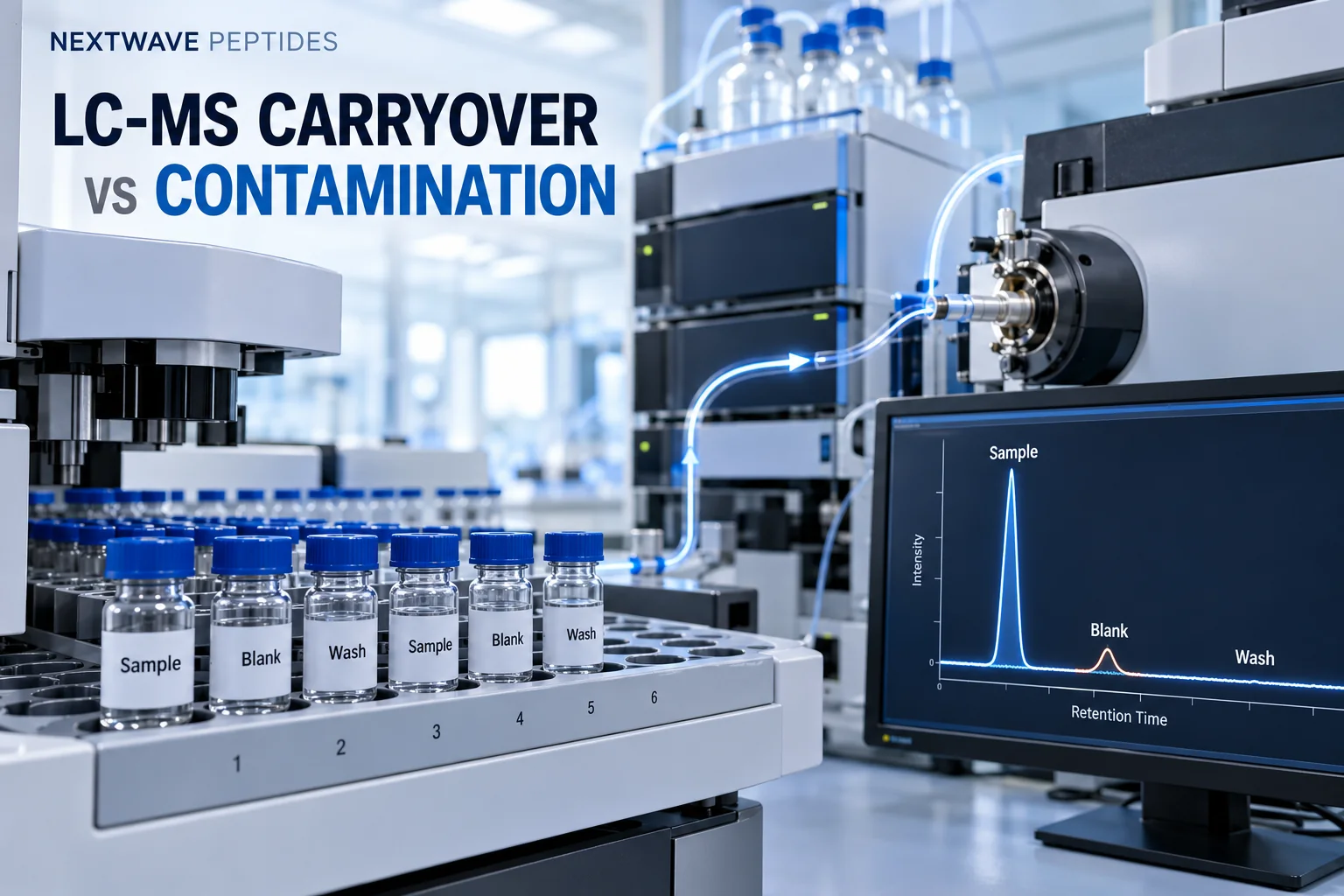
When an unexpected peptide signal appears, record what ran immediately before it, where the blank entered the workflow, and whether the same retention time and ions recur. A blank injected after a high-concentration sample tests the injection path and LC system. A preparation blank that passes through tubes, tips, and reagents tests more of the sample workflow. A solvent blank prepared independently narrows the question further.
The peptide adsorption and recovery guide describes the surfaces that can retain material. The research peptide documentation workflow shows how to preserve injection order, preparation history, and method version instead of reporting an unexplained “extra peak.”
What does each control test?
| Control | Main question | Interpretation limit |
|---|---|---|
| Sequence blank after a sample | Did the preceding injection leave a detectable residue? | Does not locate the exact wetted component |
| Repeated blank | Does the signal decay across injections? | Decay supports carryover but is not chemical identity proof |
| Preparation blank | Did preparation materials introduce the signal? | Still includes instrument background |
| Fresh mobile-phase blank | Is the signal present without sample preparation? | May not reproduce vial or extraction effects |
| Targeted needle/seat/column wash | Which cleaning change reduces the signal? | Reduction alone does not validate the full method |
A nano-LC-MS investigation of peptide and protein carryover evaluated autosampler, trap-column, and analytical-column contributions and used dedicated wash steps to reduce persistence (PubMed 19537771). For regulated bioanalytical work, the FDA's adopted ICH M10 guidance treats carryover as a method-validation question and expects blank samples after high-concentration samples to be evaluated against defined criteria (FDA ICH M10 guidance). Those criteria apply to the validated context described in the guidance; they are not universal specifications for every research assay.
A practical diagnostic sequence
First, preserve the original injection order and raw data. Then inject an appropriate blank without changing multiple variables at once. If the signal follows a high sample and decays with repeated blanks, investigate the needle, seat, loop, tubing, trap, and column. If it is already present in a preparation blank, review reagents, vials, pipette tips, bench workflow, and shared standards. If it appears at different retention times or with incomplete ion agreement, do not call it the same peptide solely from one selected ion.
The peptide stereochemistry and mass identity guide explains why mass agreement alone is insufficient. For batch-specific comparisons, use the method and source files linked through the NEXTWAVE PEPTIDES COA library.
Product context must also remain exact. A signal associated with a Tirzepatide research material, Semaglutide research material, or Cagrilintide research material should be evaluated with the matching reference and method. The GLP-1 research collection is a navigation group, not evidence that these molecules share retention or wash behavior.
Research limitations
Carryover varies with instrument geometry, surface chemistry, mobile phase, gradient, concentration, injection volume, peptide properties, and wash program. A control sequence that works on one LC-MS platform may not transfer to another. Blank signals near the detection limit require replicate and integration review. This article describes analytical troubleshooting and does not establish the purity or safety of any product.
Frequently asked questions
Does a peak in the first blank prove carryover?
It raises that possibility, especially after a high sample, but preparation and mobile-phase controls help exclude other sources.
Should the strongest wash be used immediately?
Use a solvent compatible with the instrument, column, and analyte. Changing several conditions at once can obscure the source.
Can carryover alter quantitative results?
Yes. Residual signal can bias later samples, particularly near the lower end of a method's range.
Is the autosampler always responsible?
No. Residue can persist in the needle, seat, loop, tubing, trap, column, or source path.