
Lyophilized Peptide Cake Appearance: What Collapse, Shrinkage, and Color Can—and Cannot—Show
Direct answer: a lyophilized cake's appearance is a useful observation, but it is not a purity, identity, content, or sterility test. Collapse, shrinkage, cracking, color, and incomplete fill can flag a process or handling difference. They cannot explain the cause without measurements such as residual-moisture testing, solid-state analysis, chromatography, or mass spectrometry.
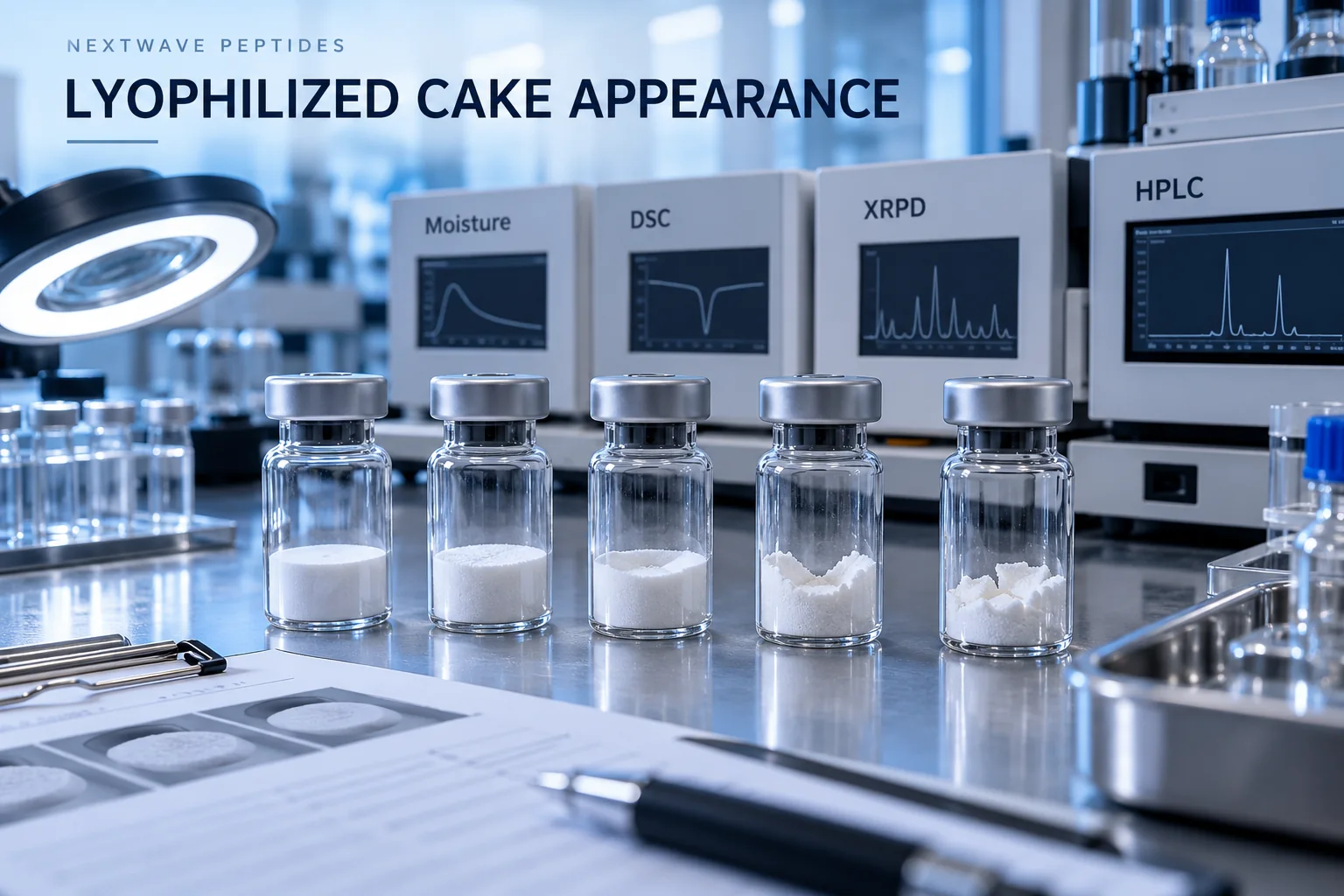
What can visual inspection record?
A controlled inspection can document whether a vial contains a uniform porous cake, localized collapse, pull-away from the vial wall, shrinkage, cracking, melt-back, discoloration, or visible foreign material. The record should include lighting, viewing angle, vial size, fill volume, batch, and time after lyophilization. Photographs become more useful when the same setup is used across samples.
Visual observations should use descriptive language. “White cake with edge shrinkage” is an observation. “Chemically stable” is a conclusion that requires analytical evidence. The research peptide documentation workflow explains how to keep observations separate from interpretations, and the guide to reading a peptide COA shows why each reported attribute needs its own method.
Which test follows which observation?
| Observation or question | Useful follow-up measurement | What it does not prove alone |
|---|---|---|
| Collapse or melt-back | Product temperature history, thermal analysis | Peptide identity or purity |
| Shrinkage or wall pull-away | Moisture, formulation, cycle review | Chemical degradation |
| Color change | Chromatography, MS, spectral comparison | The identity of a degradant |
| Variable cake height | Fill-weight and process records | Delivered peptide content |
| Visible particles | Microscopy or particle analysis | Whether particles are peptide aggregates |
Research on freeze-dried polypeptide formulations has combined cake appearance with X-ray powder diffraction, differential scanning calorimetry, residual-moisture measurements, and RP-HPLC rather than relying on a photograph alone (PubMed 41471057). Controlled ice nucleation studies in a monoclonal-antibody model likewise found that cake appearance and other quality attributes must be evaluated separately (PubMed 23618961). These models help explain measurement design, but they are not direct evidence for every peptide formulation.
Why residual moisture needs its own result
A visually elegant cake can still contain more or less residual water than expected. Conversely, an imperfect-looking cake may not imply chemical failure. Karl Fischer titration or a validated alternative provides a water measurement; it does not automatically identify the peptide or quantify chromatographic impurities. Primary-drying endpoint research has explicitly compared process signals, visual cake inspection, and Karl Fischer moisture as distinct observations (PubMed 20058107).
The peptide salt-form guide is a related example of why appearance, counterion, purity, and quantitative content should not be collapsed into one claim. For batch-specific documentation, use the report available through the NEXTWAVE PEPTIDES COA library and check which tests were actually performed.
How should a comparison be written?
Compare vials only when the product, formulation, fill, container, cycle, storage interval, and inspection conditions are identified. If those fields differ, label the comparison exploratory. Do not infer that a GHK-Cu research material, TB-500 research material, and KLOW blend research material should share the same color or cake morphology. Their compositions differ. The recovery peptide collection groups related catalog entries for navigation, not for visual-equivalence claims.
Research limitations
Much of the published lyophilization literature uses proteins, antibodies, or specific formulations. Cake behavior is formulation- and cycle-dependent, so those findings cannot be transferred without testing. A photograph may be altered by lighting, white balance, condensation, vial geometry, or camera exposure. The discussion here supports laboratory documentation only; it does not establish batch quality, safe use, or therapeutic performance.
Frequently asked questions
Does a collapsed cake mean the peptide is impure?
No. Collapse is a physical observation. Purity requires a defined analytical method.
Does a white cake prove identity?
No. Many materials look white. Identity requires sequence- or structure-relevant evidence.
Can two vials from different batches look different?
Yes. Formulation, fill, cycle, container, storage, and inspection conditions can all influence appearance.
Should photographs replace analytical reports?
No. Photographs can document appearance, while analytical reports address measured attributes.