
Semax vs N-Acetyl Semax Amidate: Are They the Same Peptide?
Fact-checked by NEXTWAVE PEPTIDES Editorial Team
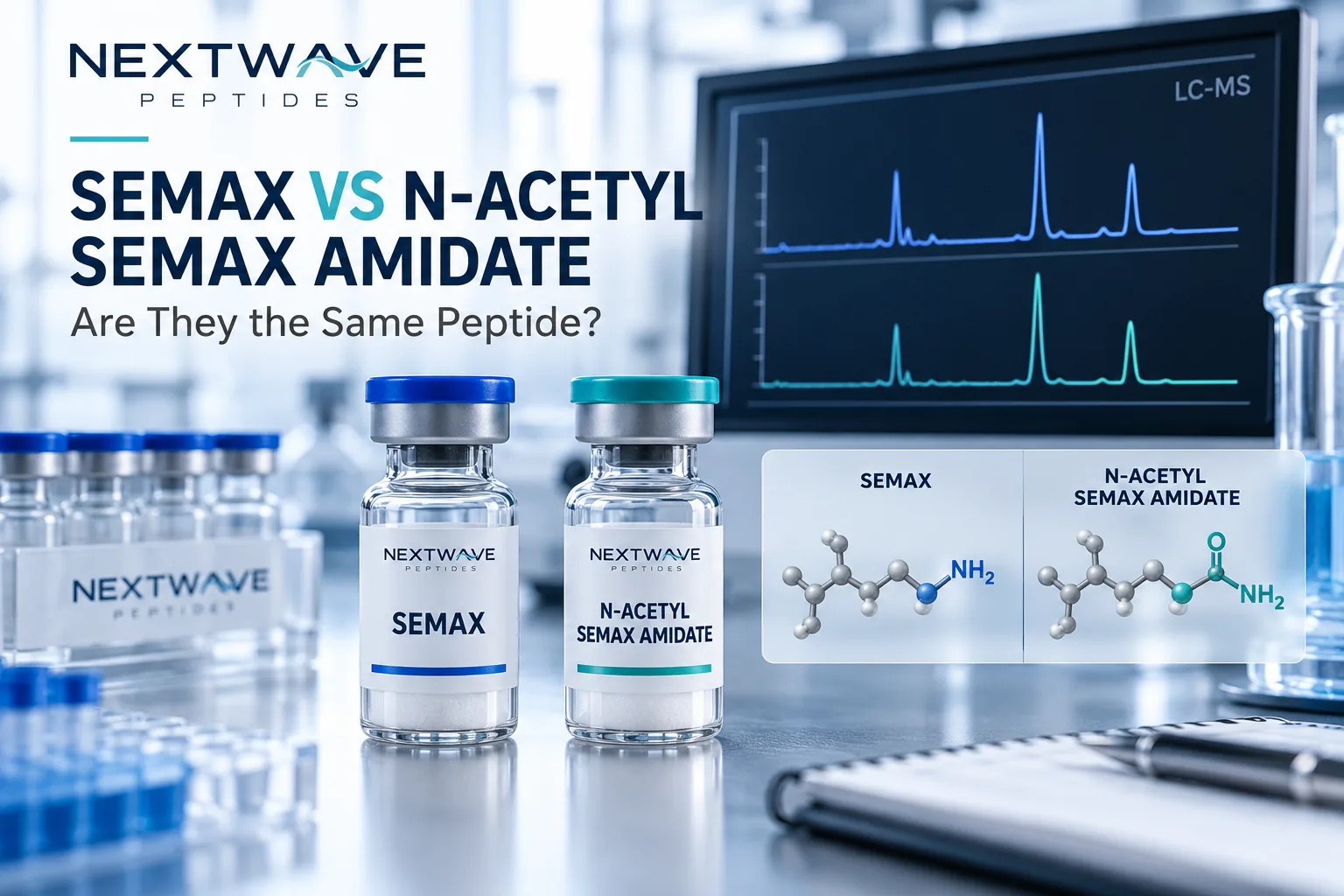
Direct answer: No. Standard Semax is reported in primary literature as the heptapeptide ACTH(4–7)-Pro-Gly-Pro. “N-acetyl Semax amidate” describes a terminally modified form with an acetylated N-terminus and an amidated C-terminus. Those changes create a different molecular entity, so identity, exact mass, purity, stability, and biological evidence must be documented separately.
Start with the exact molecular name
The label “Semax” is often used loosely, but primary literature provides a defined starting point. A Semax chemistry study indexed by NIH PubMed describes Semax as a heptapeptide containing the ACTH(4–7) sequence followed by Pro-Gly-Pro. Another primary rat transcriptome study indexed by NIH PubMed explicitly identifies ACTH(4–7)PGP as Semax.
Adding “N-acetyl” and “amidate” changes both ends of that peptide record. N-terminal acetylation caps the free amino terminus. C-terminal amidation replaces the terminal carboxyl form with an amide. Even when the residue order in the middle is unchanged, the terminal functional groups are part of molecular identity.
| Identity field | Standard Semax record | N-acetyl Semax amidate record | Why it matters |
|---|---|---|---|
| Core residue sequence | ACTH(4–7)-Pro-Gly-Pro | Same core sequence may be claimed | Sequence alone does not capture terminal chemistry |
| N-terminus | Unmodified form described in the cited Semax papers | Acetylated | Changes formula, mass, charge behavior, and method expectations |
| C-terminus | Free carboxyl terminus in the standard peptide record | Amidated | Changes formula, mass, charge state, and fragmentation context |
| Literature transfer | Findings apply to the exact Semax material used in each study | Requires studies naming and characterizing the modified form | Similar naming does not prove equivalent behavior |
This table yields the key information gain: sequence identity is necessary but insufficient. A defensible comparison must include terminal form.
Terminal modifications change the analytical target
An intact-mass method should use the theoretical mass for the exact terminal form being tested. A result that matches standard Semax should not be used to identify the doubly modified peptide, and a result matching the modified form should not be labeled simply as unmodified Semax without qualification.
Retention time may also differ because terminal modifications can alter charge and hydrophobic interactions. A purity percentage from RP-HPLC does not identify which molecular form produced the main peak. Identity therefore requires orthogonal evidence such as mass data matched to the exact specification, with sequence or fragment confirmation when the research question requires it.
The Semax intact-peptide and fragment guide explains why disappearance of a parent signal and appearance of fragments are separate observations. The Semax and ACTH fragment guide shows why a familiar fragment name is not enough to establish the complete peptide.
Published Semax evidence cannot be silently reassigned
The cited primary studies identify the material they studied as Semax or ACTH(4–7)PGP. Unless a paper explicitly states that it used an N-acetylated and C-amidated form, its findings should not be presented as direct evidence for that modified molecule.
This is not a claim that terminal modification has no effect or must have a particular effect. It is a source-matching rule. Modification may influence susceptibility to some exopeptidases, chromatographic behavior, ionization, receptor interactions, distribution, or other properties, but each proposed difference needs its own method and evidence. A plausible chemical rationale is not a measured outcome.
The Semax half-life guide separates chemical stability, matrix degradation, pharmacokinetics, and duration of a measured response. That separation is especially important here: modifying a peptide terminus does not justify a numeric half-life claim without a study of the exact molecular form in a defined matrix and method.
A minimum identity record for comparing the two forms
A useful comparison should disclose:
- the full residue sequence;
- N-terminal form;
- C-terminal form;
- counterion or salt form, where relevant;
- theoretical neutral and ion masses used for assignment;
- observed mass and mass error;
- chromatographic method and purity calculation;
- any sequence-confirming fragments;
- sample matrix, storage, and preparation conditions.
If a source lists only “Semax” and a purity percentage, the identity record is incomplete for distinguishing the two forms. If it lists “N-acetyl Semax amidate” without a structure or mass target, the modifier words have not yet been analytically verified.
How to interpret a study or catalog record
First match the paper's stated material to the exact sequence and terminal form. Next separate analytical identity from functional results. Then record the model: purified system, cells, animals, or humans; the route and exposure; the time point; and the endpoint. Only after those fields match should two results be compared.
A Semax research material should be assessed against its own specification and lot documentation. The Research Compounds collection groups catalog records for navigation but does not make modified and unmodified forms equivalent. Batch documents available from NEXTWAVE PEPTIDES can be checked in the COA library; each document applies only to the material and lot it identifies.
For a purchasing-focused follow-up, the Semax price and COA supplier guide applies these identity differences to sequence, form, package, and lot verification.
Research limitations
This article performs a structure-and-evidence comparison; it does not report an original experiment. The cited primary papers characterize standard Semax, not a direct head-to-head experiment between Semax and N-acetyl Semax amidate. Public naming for the modified form is inconsistent, so any material bearing that name requires an exact structure and analytical record. No claim about superior stability, potency, bioavailability, or human effect is made without direct evidence for the modified molecule.
Frequently asked questions
Is N-acetyl Semax amidate just another name for Semax?
No. The name specifies changes at both peptide termini, so it describes a different molecular form.
Can HPLC purity distinguish the two forms?
Not by itself. HPLC can separate peaks under a stated method, but identity requires matching the exact molecular target with suitable orthogonal evidence.
Do standard Semax studies prove effects of N-acetyl Semax amidate?
No. Evidence should remain attached to the exact material used in each study unless a direct comparison supports transfer.
Does terminal modification prove a longer half-life?
No. It can motivate a stability study, but a numeric half-life requires direct measurement of the exact form in a defined system.