
Semax Stability Studies: Why an Intact Peptide Signal Is Not the Same as a Fragment Profile
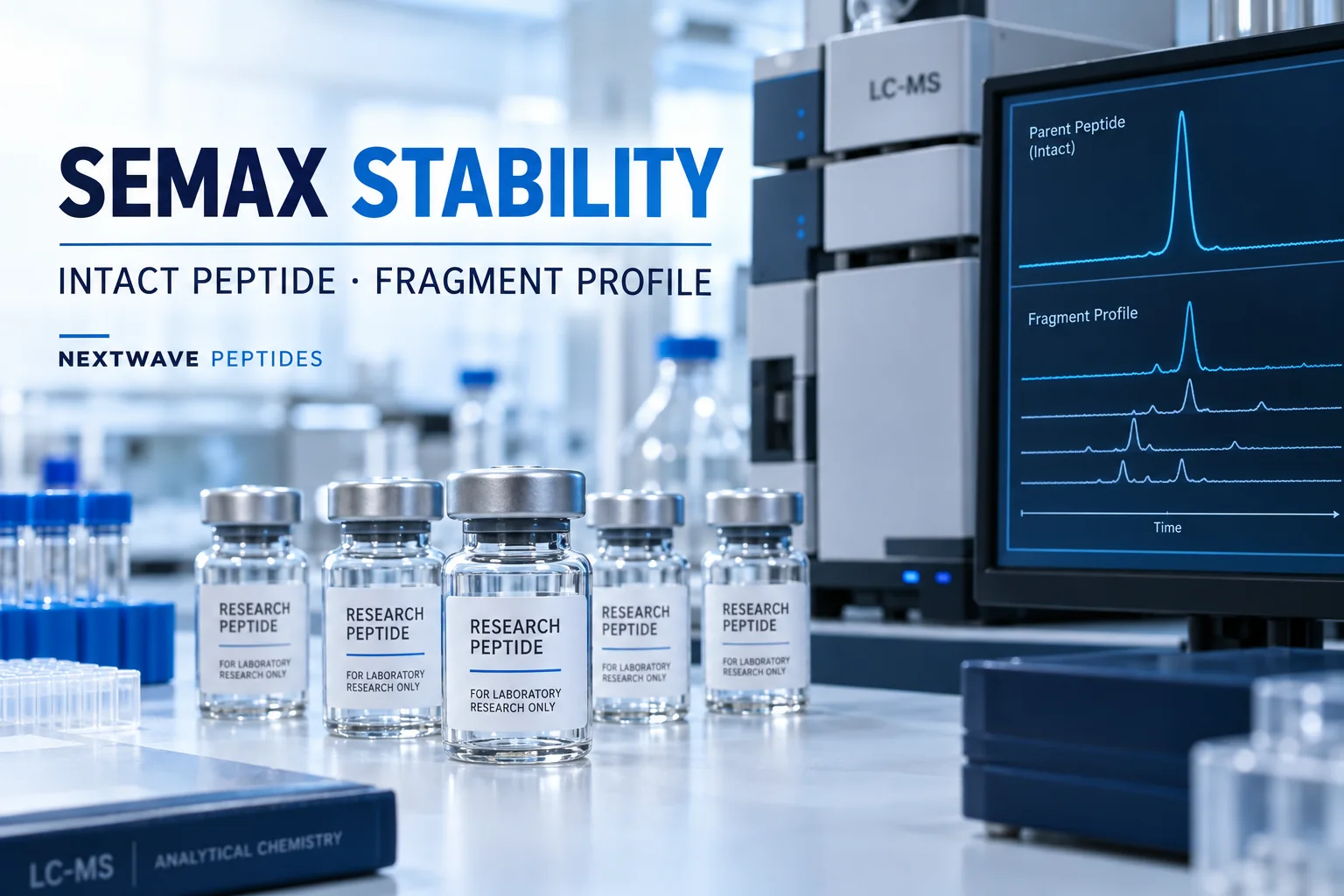
An intact Semax signal and a Semax-derived fragment profile answer different analytical questions. Stability studies ask how much parent heptapeptide remains under defined conditions and which products appear over time. Detecting a fragment does not prove that intact Semax is present at the same time, and detecting the parent does not identify every degradation pathway.
What is the parent material?
Semax is commonly described by the heptapeptide sequence Met-Glu-His-Phe-Pro-Gly-Pro. A study record should also state whether the material is the free base, acetate, an N-terminally modified analogue, isotopically labeled material, or another form. These distinctions affect what analytical peaks and degradation products should be expected.
The word “Semax” should not be applied automatically to every Pro-Gly-Pro-containing fragment. A fragment can share residues with the parent while differing in length, terminal chemistry, mass, chromatographic behavior, and biological context.
Parent stability and fragment formation are separate measurements
A publication on an acetylated Semax analogue examined proteolytic stability in multiple biological media. The paper title and indexing make the material distinction explicit: the study concerns “Semax acetyl,” not an unqualified catalog material. Its results therefore belong to that modified construct and the reported media. Shevchenko et al. (2013)
An FDA scientific review of Semax-related bulk substances summarizes older metabolism reports in which sequential N-terminal proteolysis and Pro-Gly-Pro-containing products were discussed in animal samples. The review also distinguishes Semax free base from Semax acetate and evaluates the limitations of the available record. It is an authoritative evidence synthesis, not a lot test or an approval of a NEXTWAVE PEPTIDES material. FDA Semax briefing document (2026)
Analytical questions that should stay separate
| Question | Suitable evidence | Common overreading |
|---|---|---|
| Is intact Semax present? | Retention, precursor and product-ion evidence for the defined parent | Assuming every related fragment is also absent or present |
| How fast does parent signal decline? | Time-course measurements in a stated matrix and temperature | Treating one in-vitro half-life as universal |
| Which fragments form? | Fragment-aware LC-MS/MS or radiolabeled metabolite mapping | Calling each fragment “Semax” |
| Is a preparation correctly identified? | Orthogonal identity evidence and matched reference material | Treating one nominal mass as complete identity |
| Does a fragment have an independent effect? | A separate experiment using the isolated, defined fragment | Inferring activity from its detection as a metabolite |
This separation is central to peptide research. Degradation can reduce parent signal while producing several fragments, and an assay designed only for the parent may not report those fragments at all.
Why matrix and sampling time matter
Proteolysis differs across serum, plasma, microsomal preparations, tissue homogenates, purified enzymes, and buffer controls. Temperature, pH, enzyme activity, inhibitors, adsorption, and sample handling can also change the observed profile.
Sampling time determines the question. An early time point may show mostly parent peptide; a later point may show lower parent response and a more complex fragment pattern. Comparing those samples without the time axis can turn a kinetic process into an apparent contradiction.
Identification is not the same as stability
Forensic researchers have developed LC-MS/MS screening approaches capable of identifying Semax and other research peptides in seized preparations. Such a method addresses whether a defined analyte can be detected in a particular matrix and workflow. It does not by itself establish shelf life, purity, biological activity, or lot correspondence. Vanhee et al. (2020)
Likewise, a stability experiment does not replace a product identity record. The starting material, matrix, reference standard, method, and time course must all be stated.
How to compare Semax stability papers
Record the exact parent form, sequence, terminal modification, counterion where stated, matrix, temperature, pH, incubation time, quench step, sample preparation, analytical method, reference material, and list of monitored parent and fragment ions.
The Semax and Selank Source Matching guide keeps separate peptides and sources apart. Reading Semax Animal Studies explains why time points and independent units matter. Semax Transcriptome Studies separates downstream gene-expression results from peptide identity and exposure evidence.
For the current material record, see Semax within Peptide Bioregulators. Lot-specific analytical information, when available, should be checked through the COA library without assuming that a literature stability profile applies to that lot.
Research limitations
Available Semax stability and metabolism literature uses different forms, animal models, biological media, analytical methods, and sampling schedules. Some source details are available only through abstracts or regulatory synthesis. These records do not establish human effects, dosing, safety, shelf life, storage instructions, or the performance of a catalog product.
Frequently asked questions
Does detecting Pro-Gly-Pro prove intact Semax is present?
No. Pro-Gly-Pro can be discussed as a Semax-derived product, but it is a shorter peptide and requires its own analytical identification.
Can one stability result define every matrix?
No. Enzyme composition, pH, temperature, sample handling, and analytical workflow differ across matrices.
Is Semax acetate analytically identical to the free base?
They share the same peptide backbone, but the stated material form and counterion remain part of the record and should not be omitted.
Does LC-MS identification prove biological activity?
No. It supports analyte identification under the method conditions. Biological activity requires a separate, controlled experiment.