
Kisspeptin-10 vs Kisspeptin-54: Why Similar Receptor Affinity Does Not Make the Peptides Interchangeable
Kisspeptin-10 and kisspeptin-54 share the C-terminal sequence needed for KISS1R activation, and KP-10 can show receptor affinity similar to KP-54 in defined cell assays. They are still different molecular species. Length, proteolytic stability, clearance, exposure profile, administration design, and downstream sampling can make their in-vivo results diverge.
What the numbers mean
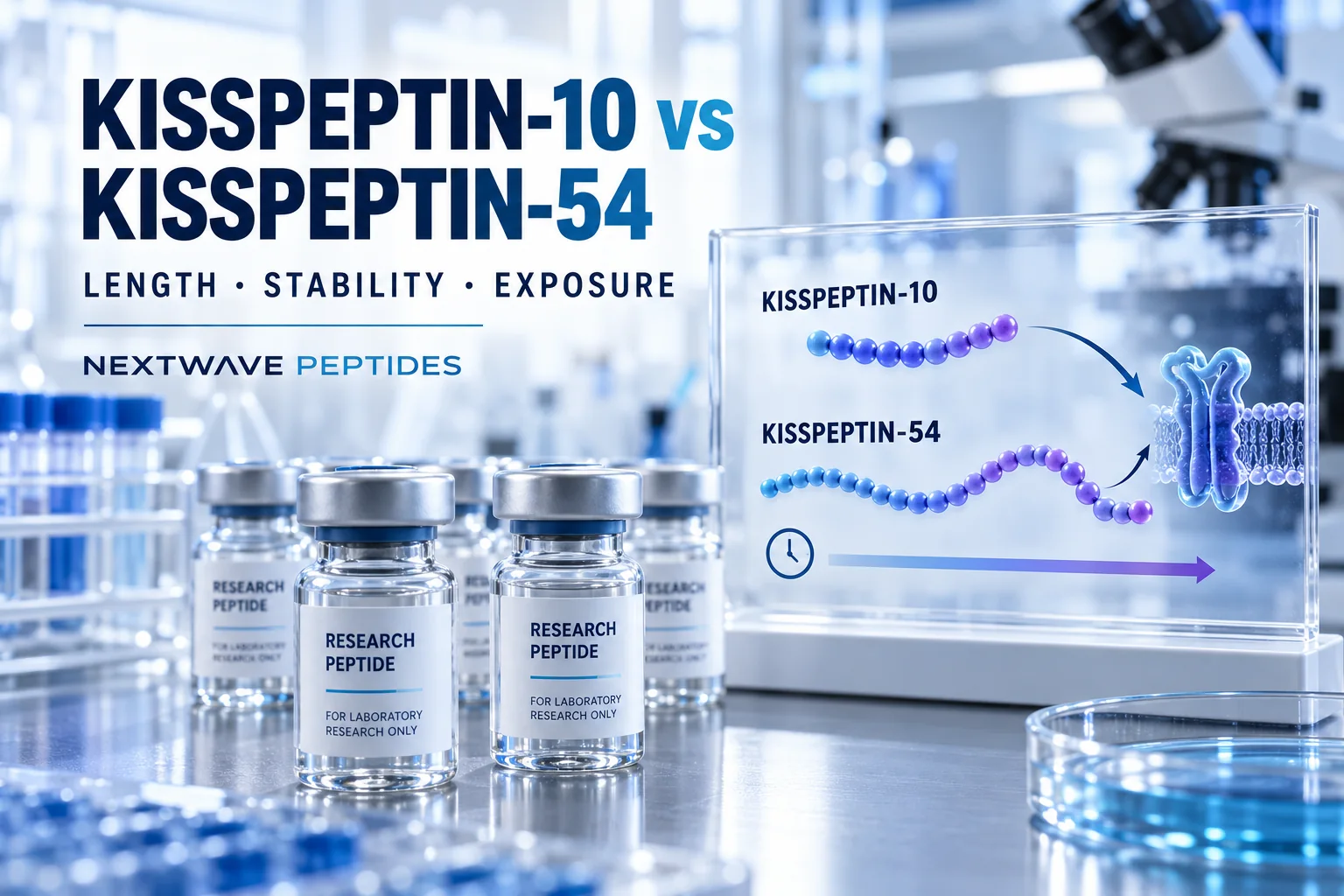
Kisspeptin peptides are processed from the KISS1 precursor. The number indicates peptide length: KP-54 contains 54 residues, while KP-10 is the C-terminal decapeptide and the shortest endogenous form commonly described as retaining full intrinsic receptor activity.
This relationship is a fragment relationship, not a synonym relationship. A literature database should preserve KP-54 and KP-10 as separate materials even when both are discussed under “kisspeptin.” It should also distinguish KP-13, KP-14, and synthetic analogues.
Receptor affinity and in-vivo response ask different questions
A structure-activity study reported that KP-10 bound human KISS1R with affinity similar to KP-54 in the defined receptor system, while noting lower in-vivo effectiveness that could reflect faster enzymatic breakdown or clearance. The same study modified KP-10 and showed that an analogue with lower receptor affinity could produce a stronger short-term in-vivo hormone response under its mouse protocol. Curtis et al. (2010)
That result illustrates a general rule: receptor affinity is one determinant of response, not the complete explanation. Exposure, degradation, tissue access, receptor reserve, signaling kinetics, and measurement time can change what is observed in an intact organism.
Comparison framework
| Dimension | KP-10 | KP-54 | Why the distinction matters |
|---|---|---|---|
| Molecular identity | 10-residue C-terminal peptide | 54-residue processed peptide | They have different mass and degradation pathways |
| Receptor assay | Can activate KISS1R in defined systems | Can activate the same receptor | Similar affinity does not prove identical kinetics |
| In-vivo exposure | Often shorter and more sensitive to degradation | Different clearance and persistence | Matched administered amount does not guarantee matched exposure |
| Endocrine readout | LH/FSH response depends on protocol and time | Same endpoints can be measured | Sampling schedule can alter apparent magnitude |
| Analytical method | Requires KP-10-specific identification | Requires KP-54-specific identification | Immunoreactivity may not resolve every molecular form |
What a direct human comparison contributes
A crossover study directly compared intravenous KP-10, KP-54, and GnRH in healthy men using repeated hormone sampling. Because each participant received the study conditions in randomized order, the design reduced some between-person variation. It still involved small groups and a particular infusion protocol, so its time profiles should not be generalized to other routes or populations. Jayasena et al. (2015)
The key value of the paper is not a universal ranking. It is the matched design: peptide identity, administration period, sampling frequency, and LH/FSH endpoints were defined together. A comparison drawn from separate studies would carry more confounding differences.
Why endpoint timing matters
KP-10 can produce rapid endocrine changes. A study in healthy men used bolus and continuous-infusion designs and analyzed LH concentration, pulse frequency, and secretory burst mass. Those are related but distinct endpoints, and the response depended on the exposure schedule and analysis window. George et al. (2011)
A single peak, area under the curve, pulse frequency, and total observation-window response should therefore occupy separate columns. The same study can support more than one statement, but each statement must name the endpoint.
How to build a clean kisspeptin record
Record peptide length, exact sequence, terminal form, species, route, infusion or bolus design, sampling schedule, assay specificity, baseline endocrine state, and every reported endpoint. If a method reports “kisspeptin immunoreactivity,” check whether it distinguishes intact KP-54 from shorter forms.
The Kisspeptin, GnRH, and Gonadotropin map explains where each signal sits in the pathway. The research-peptide naming guide helps prevent fragments and analogues from being merged, and the literature matrix workflow keeps route, time, and endpoint visible.
See Kisspeptin-10 in Research Compounds for the current catalog identity. That product record does not establish the endocrine outcomes of KP-10 or KP-54 studies.
Research limitations
The cited evidence spans receptor systems, mice, and small human studies with defined administration and sampling protocols. It does not establish clinical use, safety, dosing, fertility outcomes, or equivalence between a catalog lot and a study material.
Frequently asked questions
Is KP-10 simply a shorter name for KP-54?
No. KP-10 is a defined C-terminal fragment of the kisspeptin precursor family; KP-54 is a longer processed peptide.
Does similar KISS1R affinity mean equal in-vivo activity?
No. Stability, clearance, exposure, tissue access, and sampling time can produce different in-vivo results.
Can an antibody assay distinguish KP-10 from KP-54?
Only if the method has demonstrated that specificity. A general immunoreactivity signal may include more than one molecular form.
What is the fairest comparison?
A matched study that defines both peptides, uses the same model and protocol, and reports the same endpoints and time points.