
Ipamorelin Selectivity: What Did the Original GH-Release Experiments Actually Show?
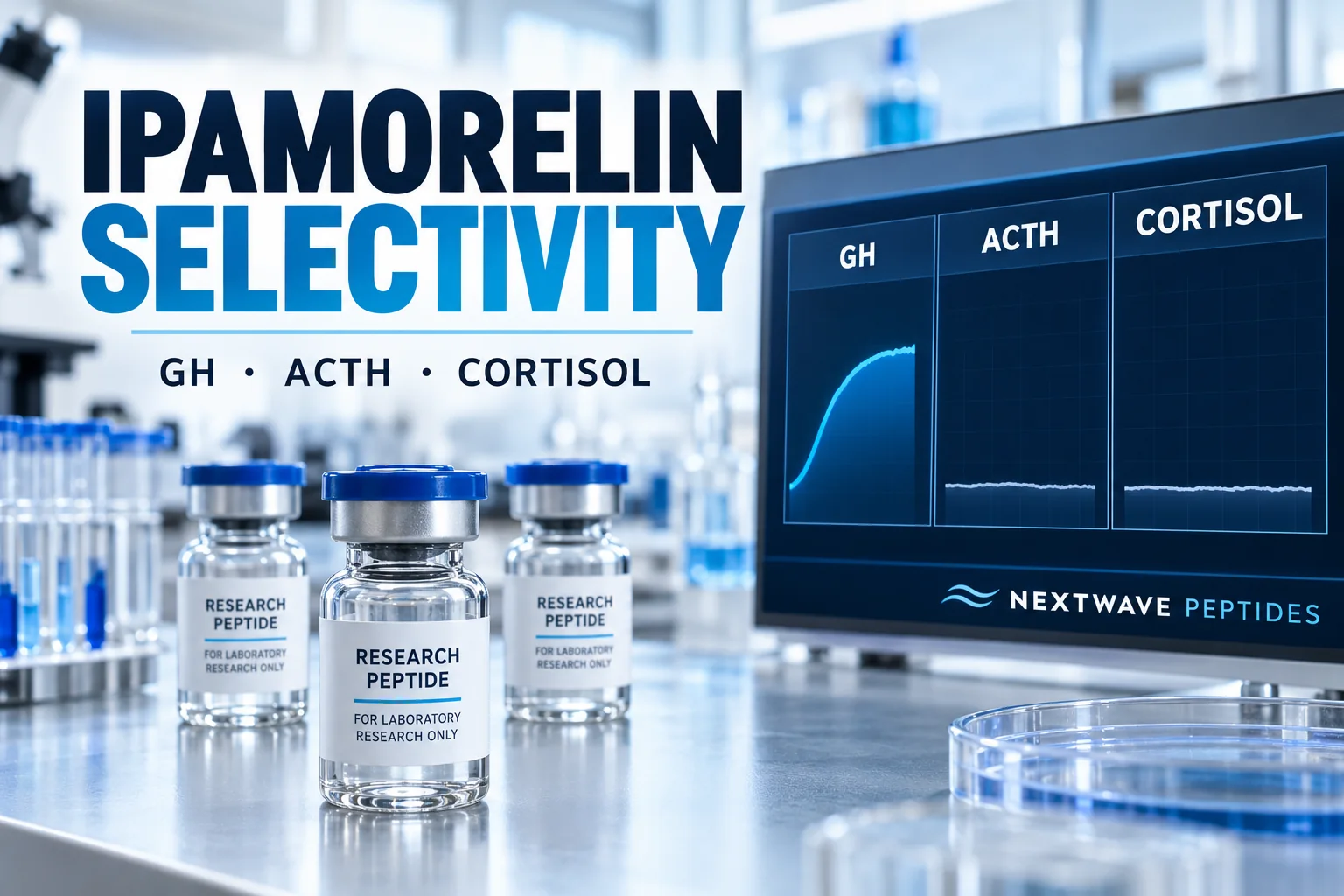
In the original ipamorelin experiments, “selective” described an endocrine response pattern: the peptide produced growth-hormone release in the tested pituitary and animal systems without the same ACTH and cortisol increases observed with some comparator secretagogues. It did not prove that ipamorelin binds only one molecular target or produces the same hormone profile in every species, preparation, or assay.
Selectivity needs an object and a measurement
Ipamorelin is a synthetic pentapeptide, commonly written as Aib-His-D-2-Nal-D-Phe-Lys-NH2. That identity includes non-proteinogenic residues and a C-terminal amide, so “ipamorelin” should not be used as a loose synonym for GHRP-2, GHRP-6, ghrelin, or another growth-hormone secretagogue.
The 1998 pharmacology paper assessed several layers of evidence. Primary rat pituitary cells supplied an in-vitro GH-release endpoint. Antagonist experiments were used to classify the pathway as GHRP-like rather than GHRH-like. Rat and swine studies then measured circulating hormones after exposure. In the swine experiments, GHRP-2 and GHRP-6 increased ACTH and cortisol, whereas ipamorelin did not differ significantly from the GHRH comparison for those endpoints. That pattern supported the authors’ phrase “selectivity for GH release” within the tested design. Raun et al. (1998)
Four claims that should remain separate
| Claim | Evidence that can support it | What it does not establish alone |
|---|---|---|
| Ipamorelin releases GH | A controlled pituitary-cell or endocrine study measuring GH | Direct binding affinity for a named receptor |
| The response is GHRP-like | Antagonist or receptor-defined pharmacology | Absence of every off-target interaction |
| ACTH or cortisol did not rise in one design | Matched hormone measurements and controls in that model | A universal endocrine profile across species and conditions |
| Ipamorelin activates GHSR | A receptor-defined binding or signaling assay | The size or timing of GH release in an intact organism |
This separation matters because a circulating hormone is several steps downstream from receptor occupancy. Receptor expression, pituitary state, feedback loops, sampling time, assay sensitivity, and species biology can all shape the final readout.
Why “GHRP receptor” and “ghrelin receptor” both appear
Early secretagogue papers often used “GHRP receptor” language. Receptor nomenclature later standardized GHS-R1a as the ghrelin receptor after ghrelin was identified as its endogenous ligand. The International Union of Pharmacology review explains that synthetic peptide and nonpeptide growth-hormone secretagogues were used to characterize this receptor class before the endogenous agonist was known. Davenport et al. (2005)
That history does not change the experimental evidence, but it changes how records should be matched. A paper using older GHRP-receptor terminology may concern the receptor now called GHSR1a. The exact construct, species ortholog, cell background, ligand, and signaling endpoint still need to be checked.
Endocrine selectivity is not signaling bias
“Selective GH release” should also be distinguished from biased agonism. GHSR can engage G-protein and beta-arrestin pathways, and receptor phosphorylation or accessory proteins can alter those responses. A study that compares GH, ACTH, and cortisol does not automatically determine how ipamorelin distributes signaling between intracellular pathways.
To investigate signaling bias, researchers would need receptor-defined assays with matched expression and multiple proximal endpoints. A hormone panel is useful physiological evidence, but it is not a substitute for direct pathway measurements.
A practical reading sequence
Start with material identity: sequence, stereochemistry, terminal amide, and any stated salt form. Then record the receptor terminology used by the paper, the model, comparator ligands, antagonist design, sampling interval, and every hormone measured. Finally, separate “not significantly different” from proof of no effect; statistical resolution depends on the study size and variability.
The GHRP secretagogue terminology guide places ipamorelin beside GHRP-2, GHRP-6, hexarelin, and nonpeptide secretagogues without treating them as interchangeable. Growth Hormone Peptides explains the difference between GHRH analogues and ghrelin-receptor agonists, while the CJC-1295 and Ipamorelin comparison shows why combining two pathway labels does not merge their evidence.
For material specifications, see Ipamorelin in the Growth Hormone Peptides catalog. The catalog record identifies the supplied research material; it does not transfer the endocrine outcomes of the cited experiments to a product lot.
Research limitations
The foundational selectivity work used primary rat pituitary cells and animal endocrine models. Assays, comparators, sampling schedules, and receptor terminology have evolved since publication. The evidence does not establish human effects, dosing, safety, universal target exclusivity, or the behavior of a NEXTWAVE PEPTIDES lot.
Frequently asked questions
Does “selective” mean ipamorelin binds only GHSR?
No. In the foundational paper, selectivity primarily described the measured hormone-release profile. Exclusive molecular binding would require a different experimental claim and broader target testing.
Is GH release the same as receptor binding?
No. GH release is a downstream physiological endpoint. Binding and proximal signaling need receptor-defined assays.
Can GHRP-6 data be assigned to ipamorelin?
No. The peptides were comparators in some experiments, but they have different structures and showed different endocrine patterns under the reported conditions.
What should be recorded first?
Record the exact peptide identity, model species, assay system, comparator, time points, and measured hormones before comparing potency or selectivity language.