
FOXO4-DRI Identity: What “D-Retro-Inverso” Changes in a Peptide Record
“D-retro-inverso” identifies both chirality and sequence direction. A FOXO4-DRI record must therefore specify D-residue identity, the reversed sequence relative to its parent motif, terminal groups, and any attached delivery sequence. A matching amino-acid composition or nominal mass cannot distinguish the retro-inverso construct from its all-L parent.
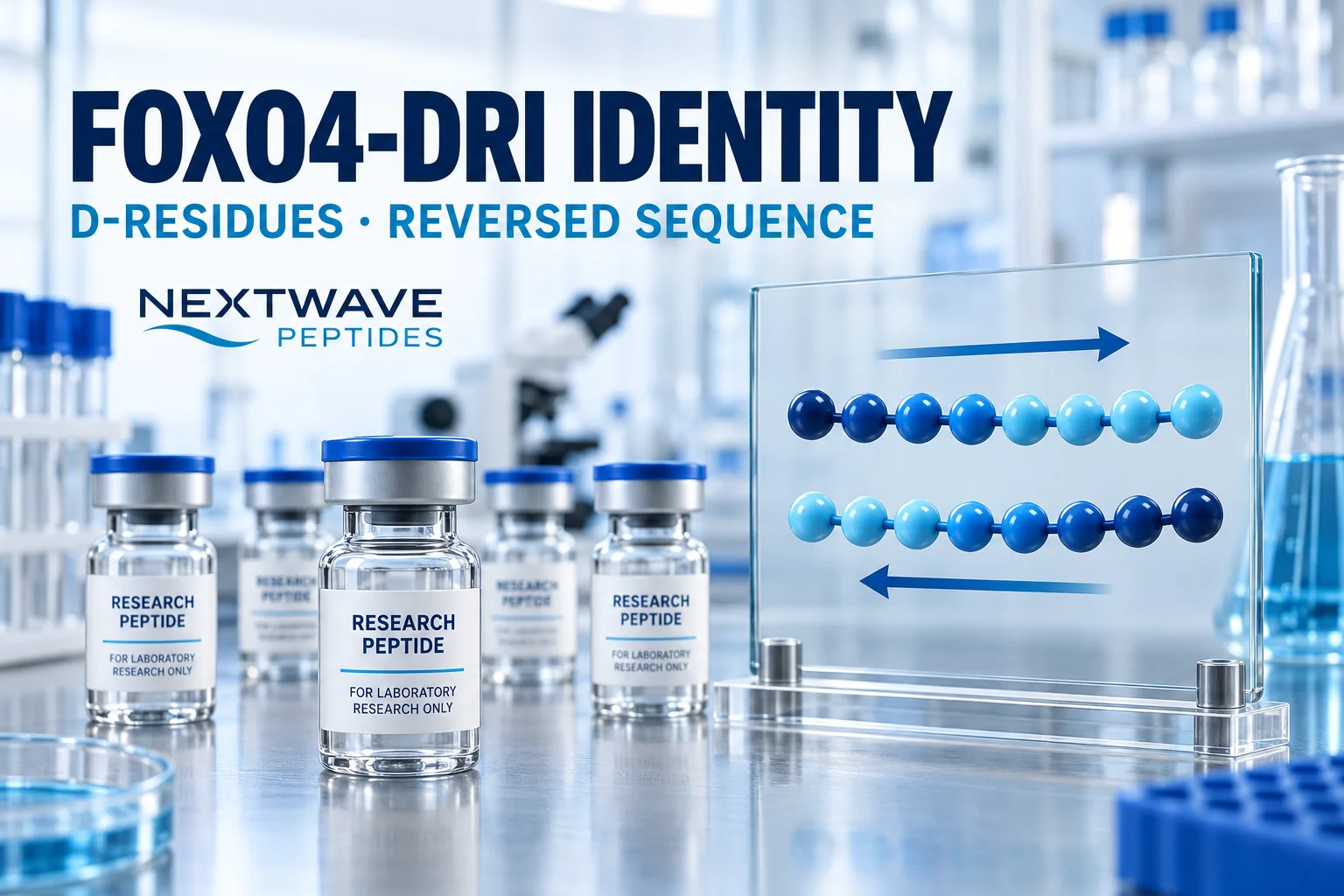
What does D-retro-inverso mean?
A retro-inverso peptide is built from D-amino acids arranged in the reverse order of the corresponding L-peptide. When an extended retro-inverso chain is viewed against its parent, the side-chain order can approximate the original spatial progression, while the backbone amide direction and terminal arrangement are reversed.
That approximation is the design idea, not proof of identical three-dimensional structure or binding. Reviews of retro-inverso design emphasize that the approach can increase resistance to many proteases, but conformational mimicry and target affinity remain case-specific. Folded or helical parent peptides may not be reproduced simply by reversing sequence and chirality. Caporale et al. (2021)
Why FOXO4-DRI must be named as its own material
The original FOXO4 peptide study examined disruption of the FOXO4-p53 interaction in senescent-cell models and used a D-retro-inverso construct. The reported cellular and mouse findings belong to that defined construct and study design. They should not be reassigned to an all-L FOXO4 segment, a sequence written in the opposite direction, or a product whose terminal form is unspecified. Baar et al. (2017)
The word “FOXO4” names the protein context. “DRI” describes the designed peptide topology. Both parts are required. Omitting D-residue configuration or reverse order removes information needed to reproduce the material.
Identity fields that answer different questions
| Field | What it establishes | What it cannot establish alone |
|---|---|---|
| Residue composition | Which amino-acid types are present | Their order or chirality |
| Written sequence | Residue order in the stated convention | Whether residues are L or D unless marked |
| D-residue statement | Stereochemical configuration | Correct reverse order or terminal form |
| Nominal or exact mass | Compatibility with a proposed composition | Sequence direction and most stereochemical differences |
| Terminal groups | N- and C-terminal chemical form | Target binding or cellular uptake |
| Functional assay | Response in a defined model | Full analytical identity of another lot |
Because an L peptide and its retro-inverso analogue can share composition and mass, orthogonal identity information is especially important. Mass spectrometry can support composition and fragmentation, but the analytical plan must be capable of resolving sequence and stereochemical questions rather than assuming them from one precursor mass.
Retro-inverso does not mean “mirror copy”
The phrase is sometimes shortened to “mirror peptide,” but that wording hides two changes. An all-D peptide with the same written sequence is an enantiomeric or inverso construct. A D-retro-inverso peptide also reverses sequence order. These materials are not interchangeable.
Experimental work on retro-inverso mimicry has shown that resistance to proteolysis does not guarantee preservation of a parent's protein-binding behavior. Backbone hydrogen bonding, secondary structure, terminal placement, and target contacts can all differ. A defensible interpretation therefore reports the measured interaction or endpoint rather than using “retro-inverso” as a claim of automatic functional equivalence. Li et al. (2010)
How to review a FOXO4-DRI record
First write the sequence convention explicitly, including whether it is shown N-to-C and whether the one-letter codes represent D residues. Record terminal modifications and any appended cell-penetrating segment. Then match analytical results to the same construct and lot.
The Peptide Stereochemistry guide explains why one mass value cannot settle configuration. Research Peptide Synonyms and Naming helps separate a protein-derived motif from a designed analogue. The Research Peptide Documentation Workflow keeps a literature construct, product specification, and lot record from being collapsed into one claim.
See FOXO4-DRI in Research Compounds for the current catalog record. Any available COA should be interpreted only for the named lot and reported methods.
Research limitations
The cited FOXO4-DRI work used defined cellular and mouse models. It does not establish human effects, safety, dosing, or equivalence for a catalog material. General properties of D peptides cannot replace construct-specific evidence. Sequence, chirality, terminal form, delivery segment, assay model, and endpoint must all match before results are compared.
Frequently asked questions
Can mass distinguish an all-L peptide from its D-retro-inverso analogue?
Usually not by precursor mass alone. The materials may share elemental composition while differing in chirality, order, backbone direction, and conformation.
Does D-retro-inverso guarantee the same binding as the parent peptide?
No. It is a design strategy intended to approximate side-chain topology and improve stability, but binding must be measured for the actual construct.
Is reverse sequence alone enough?
No. A retro-inverso material combines reversed sequence with D-amino-acid configuration.
Why record terminal groups?
Reversing a peptide changes the relationship between sequence and termini. Terminal chemistry can affect mass, charge, conformation, and analytical interpretation.