
DSIP Dosage in Human Sleep Studies: Protocols, EEG Endpoints & Side Effects (2026)
Direct answer: Human DSIP studies did not establish one universal dosage. Several small sleep experiments used 25 nmol/kg by slow intravenous infusion, but protocol timing and outcomes differed. A six-volunteer crossover study reported acute sleep pressure and later sleep changes, while a 16-patient double-blind insomnia study found only weak objective effects across three treatment afternoons and little change in other measures. These historical protocols are research records—not personal dosing instructions.
Fact-checked by NEXTWAVE PEPTIDES Editorial Team
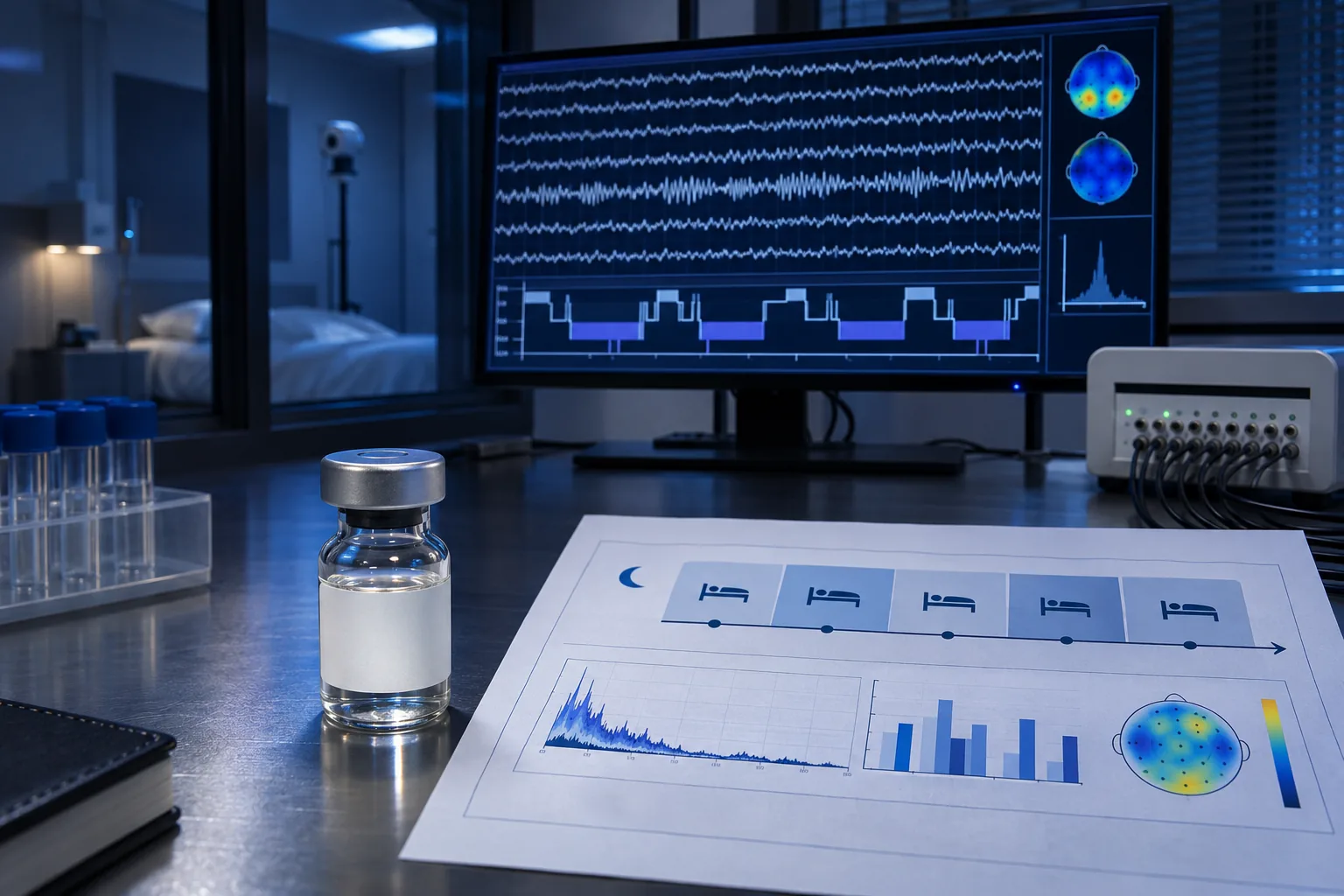
The current DSIP research peptide record appears in the Research Compounds collection. Exact sequence, form, lot and stability should be fixed before an older human protocol is connected to a modern laboratory material.
Human DSIP dosage records compared
| Study | Population | Reported protocol | Main endpoints | Key finding |
|---|---|---|---|---|
| 1981 acute and delayed study | 6 healthy volunteers | 25 nmol/kg slow IV infusion in morning | 130-minute sleep interval and subsequent night | Acute sleep pressure plus delayed sleep changes reported |
| 1992 chronic insomnia study | 16 patients | 25 nmol/kg IV before nights 3–5 | Polysomnography, subjective sleep and tiredness | Weak objective effects; most measures unchanged |
| 1994 endocrine study | Healthy men | 25 nmol/kg over 10 minutes | ACTH and vasopressin responses | ACTH changed while AVP responses were not modified |
| Later intranasal clinical record | Diabetic-retinopathy patients | 0.3 mg daily for 2 months | Visual evoked potential measures | Different disease and endpoint; not a sleep-dose trial |
What DSIP is
Delta sleep-inducing peptide is a nine-residue peptide commonly recorded as Trp-Ala-Gly-Gly-Asp-Ala-Ser-Gly-Glu. It was originally associated with slow-wave EEG observations, but later research examined sleep architecture, endocrine signals and other physiological endpoints. The name describes its discovery history; it does not guarantee that every protocol increases sleep.
The DSIP sleep-evidence guide shows how species, sequence, route, baseline condition and EEG endpoint can change the result. Dose is only one variable in that matrix.
Acute sleep study in healthy volunteers
The first cited human experiment used a double-blind crossover design in six healthy volunteers. DSIP was delivered as a slow morning infusion at 25 nmol/kg. The published abstract reported increased sleep during a 130-minute post-infusion interval and later changes including shorter sleep onset and better sleep efficiency that night.
Its strengths include crossover control and objective monitoring. Its limitations include a very small sample, an unusual morning sleep opportunity and historical sleep-scoring methods. The result is best treated as evidence that acute and delayed windows can differ.
Double-blind insomnia study
A later study enrolled 16 chronic-insomnia patients in matched parallel groups. After adaptation and baseline nights, participants received DSIP or placebo before the third, fourth and fifth nights. The double-blind study reported higher sleep efficiency and shorter sleep latency, but characterized the significant effects as weak and potentially influenced by an incidental placebo-group change. Subjective sleep quality and most other measures did not change.
This mixed outcome is valuable because it prevents a single positive variable from becoming a universal sleep claim. Sleep latency, efficiency, total sleep time, stage distribution, awakenings and subjective quality should remain separate endpoints.
EEG and polysomnography endpoints
Polysomnography combines EEG, eye movements, muscle activity and other channels to stage sleep. A DSIP protocol should state scoring rules, adaptation night, baseline night, infusion time, lights-off time, recording duration and artifact handling. “More delta activity” is not automatically identical to more restorative sleep or better next-day function.
A robust table reports total sleep time, latency, wake after sleep onset, efficiency, N1, N2, N3, REM, arousals and spectral slow-wave activity separately. It also records whether an endpoint was prespecified and how multiple comparisons were handled.
Endocrine observations are a different research question
An endocrine study infused 25 nmol/kg DSIP over ten minutes in healthy men and measured arginine-vasopressin and ACTH under saline, osmotic and orthostatic conditions. The clinical study reported an ACTH decrease while vasopressin responses were not meaningfully altered.
That protocol helps map endocrine timing, but it does not establish a sleep benefit. Hormone measures, EEG changes and participant-reported sleep belong in separate evidence columns even when the same dose appears.
Route and formulation cannot be ignored
Most early sleep studies used intravenous infusion. A later intranasal record in diabetic-retinopathy rehabilitation used a different daily total, duration and endpoint. Intravenous and intranasal exposure cannot be compared from nominal dose alone because absorption, local loss, peak concentration and metabolite formation differ.
Research-material records should therefore include sequence, counterion, concentration, vehicle, delivered volume, route, infusion duration, container and stability. The research peptide documentation workflow provides a reusable chain from product page to received lot.
Side effects and safety reporting
The historical sleep abstracts provide limited modern adverse-event detail. A responsible review should distinguish events explicitly collected, events reported in the abstract and fields not available. Small studies can identify tolerability signals but cannot estimate rare-event rates or long-term safety precisely.
A contemporary protocol would prespecify adverse-event windows, vital signs, next-day alertness, withdrawal criteria and concomitant medications. It would also verify identity, content, impurities and sterility requirements appropriate to the experimental system rather than assuming that a purity percentage answers every safety question.
How to design a stronger modern DSIP study
- Use adaptation and baseline nights: reduce first-night effects before randomization.
- Predefine one primary sleep endpoint: keep secondary EEG and subjective variables labeled.
- Match placebo and timing: infusion, lights-off and recording windows should align.
- Separate acute and delayed effects: daytime sleep pressure and subsequent-night sleep are different outcomes.
- Verify the material: record intact sequence, content, lot, stability and preparation.
- Publish participant flow and adverse events: retain withdrawals and missing recordings.
The Semax protocol-review guide offers a parallel example of how older neuropeptide studies can be summarized without turning historical schedules into personal guidance. The Semax versus Selank comparison also illustrates why neighboring neural peptides should not inherit DSIP sleep endpoints.
Research limitations
Human DSIP sleep studies are small, old and heterogeneous. Some reported favorable objective variables, while others found limited or inconsistent effects. Routes, populations, timing and endpoint definitions differ, and modern replication is limited. The studies summarize research protocols rather than an approved sleep-treatment schedule.
Frequently asked questions
What DSIP dosage was used in human sleep studies?
Several early studies used 25 nmol/kg by slow intravenous infusion, but the timing, population and number of treatment days differed.
Did DSIP improve sleep in every study?
No. Some small studies reported changes in sleep efficiency or latency, while a double-blind insomnia study found weak effects across a limited set of measures.
Is intravenous DSIP equivalent to intranasal DSIP?
No. Route changes absorption, concentration-time behavior and the interpretation of a nominal dose.
What is the most informative endpoint?
A prespecified polysomnography endpoint such as sleep efficiency or latency is stronger than a broad claim, but it should be interpreted with the full sleep-stage and subjective dataset.