
CJC-1295 Half-Life: DAC vs No DAC Evidence Explained
Fact-checked by NEXTWAVE PEPTIDES Editorial Team
Direct answer: Published human trials estimated a 5.8–8.1 day half-life for the albumin-binding CJC-1295 molecule studied in those trials. That value should not be applied to “CJC-1295 No DAC,” often used as a catalog name for a short-acting modified GHRH(1–29) material. The DAC group changes covalent albumin binding and therefore changes the molecular and pharmacokinetic record.
“CJC-1295” is not specific enough for a half-life claim
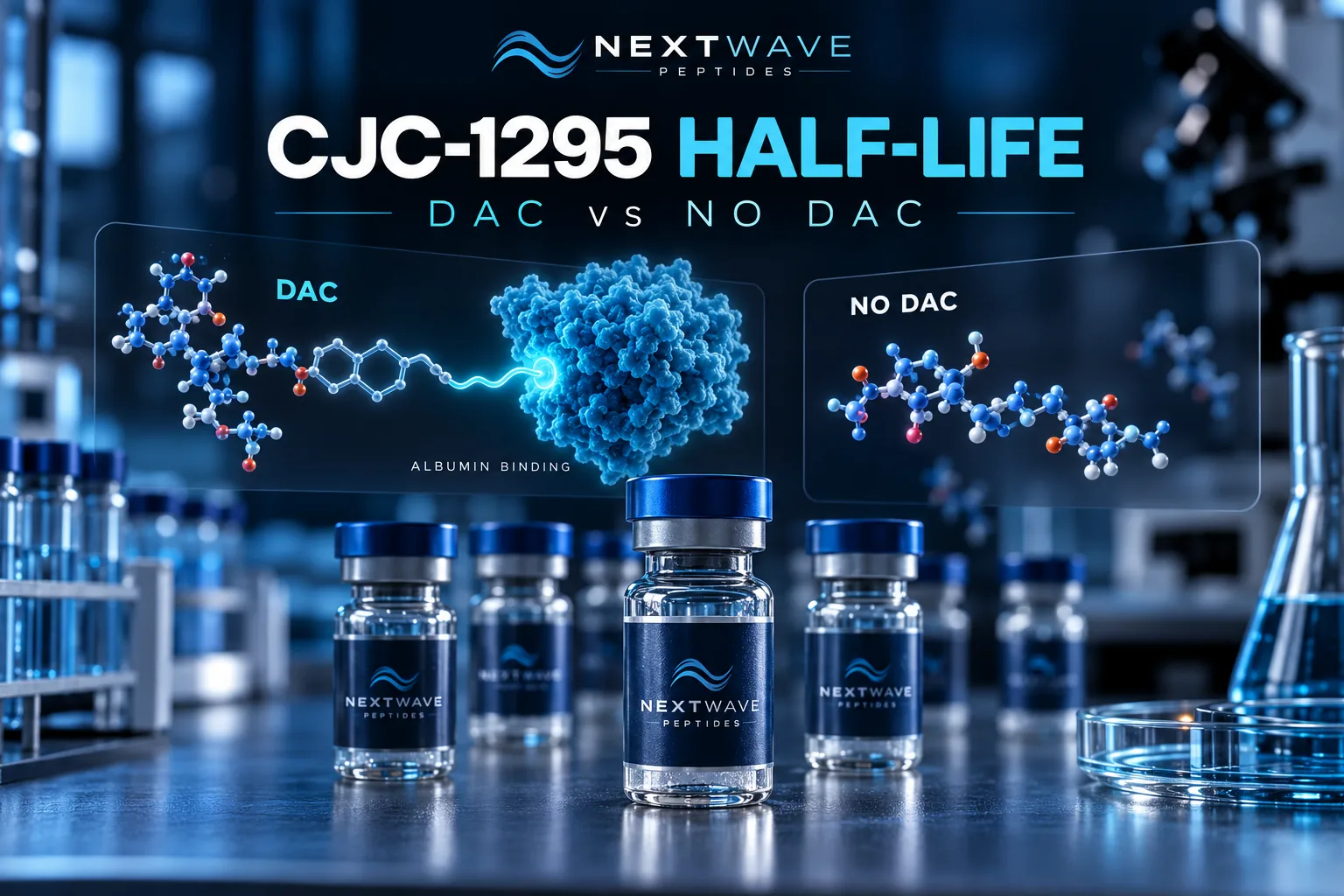
The original long-acting molecule includes a reactive Drug Affinity Complex that binds endogenous albumin. In the primary discovery study indexed by NIH PubMed, researchers described the substituted GHRH(1–29) analogue and observed an albumin-associated immunoreactive species after administration in rats.
In two randomized placebo-controlled trials in healthy adults, the primary clinical report estimated a CJC-1295 half-life of 5.8–8.1 days and reported sustained changes in GH and IGF-I under that protocol. A later human study indexed by NIH PubMed evaluated GH pulsatility one week after the albumin-binding analogue.
| Material label | Structural record | Direct half-life evidence | Defensible interpretation |
|---|---|---|---|
| CJC-1295 with DAC | Modified GHRH analogue with reactive albumin-binding group | Human estimate of 5.8–8.1 days in the cited trials | Long exposure belongs to that exact molecule and protocol |
| “CJC-1295 No DAC” | Catalog term commonly applied to a short-acting modified GHRH(1–29) material without the DAC group | No equivalent 5.8–8.1 day record from the cited CJC-1295 trials | Do not borrow the DAC estimate |
| Native GHRH(1–29) | Endogenous sequence fragment | Separate literature and rapid enzymatic degradation context | Not identical to either modified material |
| GH or IGF-I response | Downstream pharmacodynamic endpoint | Time course measured in the clinical studies | Not the same as peptide concentration half-life |
The useful original analysis is the alignment of three layers: molecular identity, peptide exposure, and downstream hormone response. A number is transferable only when all three are kept in their proper scope.
Why albumin binding changes the record
The DAC moiety was designed to react with albumin after administration. Albumin association increases the apparent circulating persistence of the conjugated material compared with an unbound short GHRH analogue. Removing that group is not a minor naming change; it creates a different molecular species with different expected mass, chromatography, binding behavior, and exposure.
The CJC-1295 with DAC vs No DAC guide covers the structural distinction. The GHRH analogue comparison places CJC materials beside sermorelin and tesamorelin without treating them as interchangeable.
Peptide half-life and GH response duration are different
The clinical trial reported both pharmacokinetic parameters for CJC-1295 and pharmacodynamic changes in GH and IGF-I. Those time courses answer different questions. A downstream hormone can remain altered after the concentration of a signaling peptide changes, and pulsatile secretion cannot be summarized by one concentration value.
When reading a half-life article, ask whether the number describes intact peptide, albumin-bound immunoreactivity, total related material, GH, or IGF-I. Mixing those endpoints can turn a correct source into an incorrect conclusion.
A practical comparison checklist
Before accepting a CJC-1295 half-life claim, verify:
- The complete molecule, including the DAC group and terminal substitutions.
- The assay's measured species and whether albumin-bound material was included.
- The species, route, dose, sampling duration, and study population.
- Whether the reported time course belongs to peptide concentration, GH, or IGF-I.
- Whether “No DAC” is chemically defined rather than assumed from a vendor label.
This checklist prevents a frequent search error: placing the 5.8–8.1 day human estimate next to a No-DAC product even though the source studied the albumin-binding analogue.
Why “30 minutes vs eight days” is not a direct trial comparison
Search pages often present a short No-DAC estimate and the 5.8–8.1 day DAC result as if one clinical study tested both materials head to head. The cited CJC-1295 trial did not do that. It measured the long-acting albumin-binding analogue. Short-acting estimates commonly come from the broader modified-GHRH literature, different analytes, or secondary summaries.
That does not make the qualitative distinction wrong; albumin binding is expected to extend exposure. It does limit the numerical comparison. A defensible table labels the DAC figure as directly measured in the cited human protocol and labels any No-DAC number with its own source, molecule, and method. Without that matched evidence, the comparison should remain directional rather than pretending to be a controlled ratio.
Study design matters when reading the long half-life
The clinical report combined pharmacokinetic sampling with GH and IGF-I endpoints in healthy adults using ascending single and repeated administrations. Its estimated half-life is therefore supported by a defined population and sampling plan, not by product marketing. However, healthy-adult data do not automatically describe another population, formulation, assay, or lot. Even a well-designed human trial remains specific to the tested material and protocol.
Applying the distinction to research materials
NEXTWAVE PEPTIDES maintains separate records for CJC DAC and CJC No DAC. The Growth Hormone Peptides collection groups them for navigation, not equivalence. A separate CJC No DAC + Ipamorelin Blend adds another component and therefore requires its own analytical record.
Lot-level documentation in the COA library can show which tests were reported for a supplied material. It cannot reproduce the cited human pharmacokinetic trial or prove that one catalog name maps to the exact study article without molecular matching.
Research limitations
The human evidence is limited to the specific long-acting CJC-1295 analogue, populations, doses, methods, and sampling schedules used in the cited trials. The studies do not validate every material sold under a CJC label. This article performs no pharmacokinetic experiment and provides no human-use or dosing advice. Its contribution is a source-grounded comparison showing exactly why the DAC and No-DAC records must remain separate.
Frequently asked questions
What is the half-life of CJC-1295 with DAC?
The cited healthy-adult trials estimated 5.8–8.1 days for the long-acting albumin-binding analogue studied there.
Does CJC-1295 No DAC have the same half-life?
No evidence supports assigning the long-acting trial estimate to the No-DAC material. Removing the albumin-binding group changes the molecule and expected exposure.
Is hormone-response duration the same as peptide half-life?
No. GH and IGF-I are downstream pharmacodynamic endpoints. Their time courses must be reported separately from the peptide's pharmacokinetic half-life.
Can a product name prove the DAC status?
No. The specification, chemical identity, mass, and lot documents must match the stated form. A shortened label is not sufficient evidence.