
AOD-9604 vs hGH Fragment 177–191: Why the Extra Tyrosine Changes the Identity Record
AOD-9604 is not simply an unmodified copy of the native human growth-hormone 177–191 segment. Authoritative descriptions define it as a 16-residue cyclic peptide built from hGH residues 177–191 with an additional N-terminal tyrosine. A record that says only “hGH fragment 176–191” can therefore hide a material difference in sequence numbering, terminal residue identity, and analytical mass.
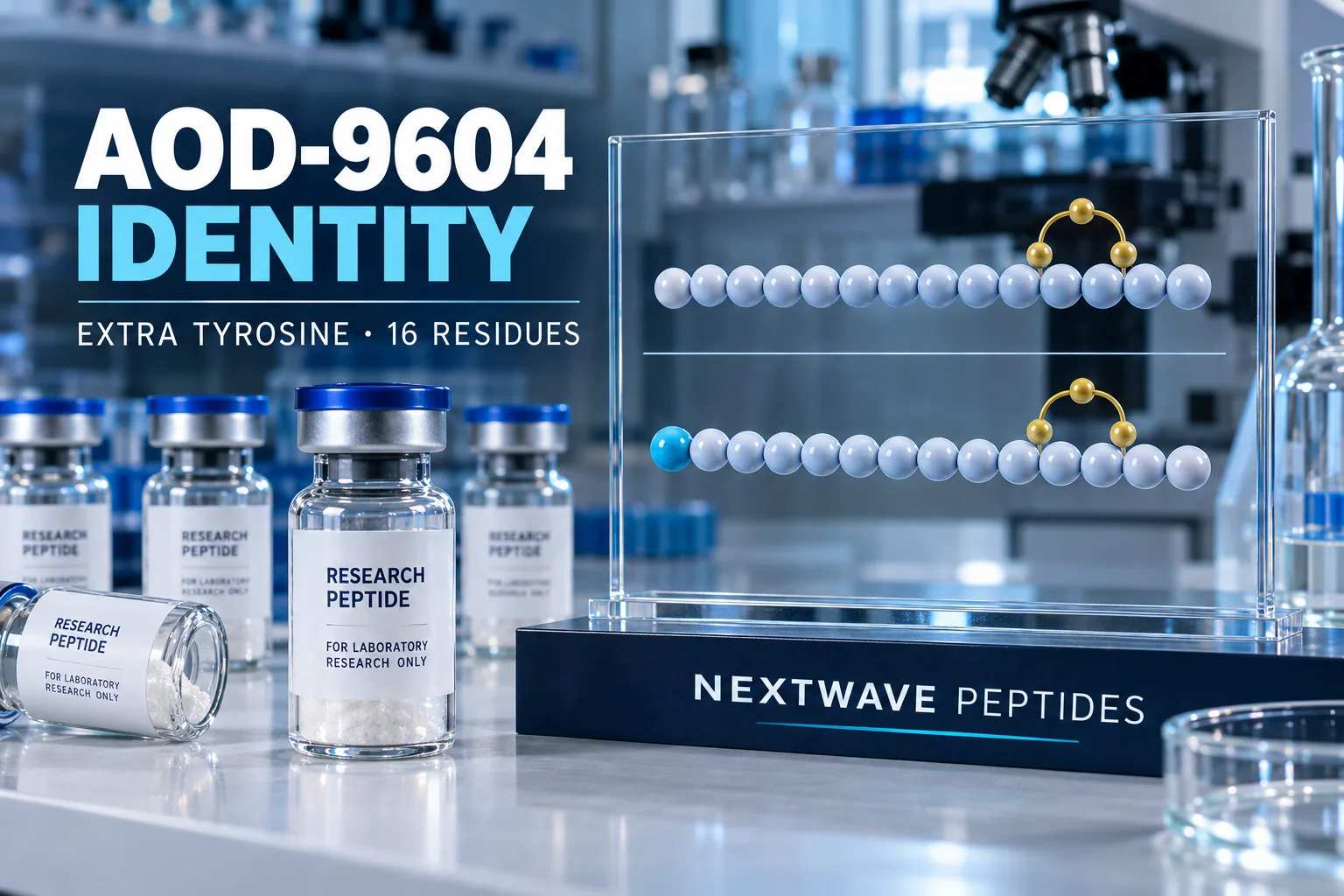
Start with the native fragment
Human growth hormone contains 191 amino acids. An early study synthesized the C-terminal sequence hGH 177–191 and reported its sequence as Leu-Arg-Ile-Val-Gln-Cys-Arg-Ser-Val-Glu-Gly-Ser-Cys-Gly-Phe. The work used rat adipose-tissue and animal endpoints to investigate antilipogenic activity. Those findings belong to that 15-residue fragment and experimental design. Wu and Ng (1993)
AOD-9604 adds tyrosine before that native segment, creating a 16-residue sequence. It also contains a disulfide connection between its two cysteines. The U.S. FDA’s scientific review describes AOD-9604 as hGH 177–191 with an additional N-terminal tyrosine and distinguishes the free base from the acetate salt. FDA PCAC scientific review (2024)
Why 176–191 and Tyr-hGH 177–191 can look similar
If the added tyrosine is counted as position 176, the 16-residue construct may be informally labeled “hGH 176–191.” If it is described by the native hGH segment from which most residues came, the name becomes Tyr-hGH 177–191. These labels can point toward the same designed construct, but only when the written sequence and disulfide form confirm that interpretation.
Numbering alone is not a complete identifier. A defensible record includes the sequence, residue count, terminal form, cysteine connectivity where known, and salt or counterion. Without those fields, the label cannot distinguish AOD-9604 from the unmodified 15-residue fragment.
Identity fields and the questions they answer
| Record field | AOD-9604 question answered | What remains unresolved |
|---|---|---|
| Name or synonym | Which literature term was used | Exact sequence and salt form |
| Residue count | Whether the material has 15 or 16 residues | Order, connectivity, and stereochemistry |
| Written sequence | Whether the extra tyrosine is present | Disulfide state unless specified |
| Intact mass | Compatibility with a proposed composition | Sequence order and complete structural identity |
| Cysteine connectivity | Whether the proposed cyclic form is supported | Purity, quantity, or biological activity |
| Salt or counterion | Whether free base and acetate are distinguished | Lot-specific analytical results |
The table also explains why a single mass value is insufficient. An intact-mass result can be consistent with the proposed molecular formula, but sequence confirmation and disulfide mapping require suitable fragmentation, reduction/alkylation, or other orthogonal methods.
Identity is separate from biological extrapolation
The native hGH 177–191 study does not automatically establish results for AOD-9604, because adding tyrosine changes the material. Conversely, a study of AOD-9604 should not be cited as direct evidence for every product labeled hGH fragment 176–191. Model, route, endpoint, starting material, and analytical definition all need to match.
The FDA review noted that submitted nonclinical articles did not always state whether free base or acetate was used. That limitation is a useful warning for literature matrices: when the material form is unclear, the uncertainty should remain visible rather than being silently resolved.
How to review an AOD-9604 record
First capture every synonym exactly as written. Then create separate fields for native segment, added residue, total residue count, N- and C-terminal forms, disulfide connectivity, and counterion. Use the paper’s own material definition instead of inferring it from a commercial nickname.
The peptide naming guide provides a method for reconciling aliases without merging different structures. Peptide Stereochemistry and Mass explains why nominal mass cannot answer every identity question. The Growth Hormone Peptides terminology guide keeps intact hGH, fragments, GHRH analogues, and secretagogues in separate classes.
For catalog context, compare the AOD-9604 research material with the separate 191-amino-acid HGH record in Growth Hormone Peptides. Lot-specific documentation, when available, should be checked in the COA library rather than inferred from a literature name.
Research limitations
The early fragment paper used rat and ex-vivo endpoints, and the regulatory review synthesizes a heterogeneous record in which material forms were not always stated. Neither source establishes human efficacy, safety, dosing, product quality, or lot correspondence. This article addresses identity and evidence matching only.
Frequently asked questions
Is AOD-9604 a 15-residue or 16-residue peptide?
Authoritative AOD-9604 descriptions identify a 16-residue construct: the 15 residues of hGH 177–191 plus an additional N-terminal tyrosine.
Does “176–191” prove the exact sequence?
No. It can function as shorthand, but the written sequence and structural fields are needed to confirm which construct is meant.
Are AOD-9604 free base and acetate identical records?
They share the same peptide active moiety, but the material form and counterion should still be recorded because they affect the complete specification.
Can intact mass confirm the disulfide bond?
It can support compatibility with a proposed form, but connectivity normally needs a method designed to resolve the cysteine linkage.